The Hidden Stories of the 'White Plague' in Kurdistan: Addiction, Incarceration, and Family Collapse
Peregraf — Ghamgin Mohammed
In a cold and desolate house in Sulaymaniyah, Asrin and her three children endure a shattered existence, oblivious to how her husband’s pursuit of wealth and fortune would leave her a young woman—solitary and defenseless.
Hundreds of kilometers away, her husband is imprisoned on the outskirts of the capital, Baghdad. He is serving a 15-year sentence for the crimes of drug use and trafficking.
"My whole life was ruined; all my dreams have vanished. Even now, I do not understand how he could do it. It is true our living conditions were not good, but I never pressured him to acquire vast sums of money; we were content with what we had," Asrin told Peregraf, still in a state of shock despite a year having passed since the incident.
The moment her husband was placed behind the closed doors of Abu Ghraib prison, all the doors of life were slammed shut in Asrin’s face, forcing her to pay the price for a crime she did not commit.
Asrin, who is still in the prime of her youth at 23, said: "For a while, I noticed my husband had changed significantly. Periodically, his psychological state was poor, but I assumed it was because he was unemployed, we were renters, and our living conditions were difficult." One day, her husband told Asrin he had found work transporting chickens by truck from Kirkuk with a friend. That news was enough to make her happy, "but then he left and never returned."
A day after his disappearance, his phone was turned off. After much uncertainty, it became clear a week later that he had been arrested in possession of narcotics.
"My husband was sentenced to 15 years in prison on charges of drug use and trafficking. I am very angry with him because he destroyed our entire lives and brought shame upon me and my children," Asrin said, her heart heavy with grief, particularly for her children. Her eldest is seven years old. Bereft of a source of income or support, the taunts and remarks of society have exhausted them further.
Dozens of similar stories are recurring in the Kurdistan Region of Iraq, where narcotics have become a nightmare, silently dismantling families.
A Silent Threat in Numbers
Narcotics are described as the most dangerous threat to global society, and the Kurdistan Region is not exempt from this peril, the damages of which are immeasurable—ranging from family collapse and social issues to physical, psychological, and economic ruin.
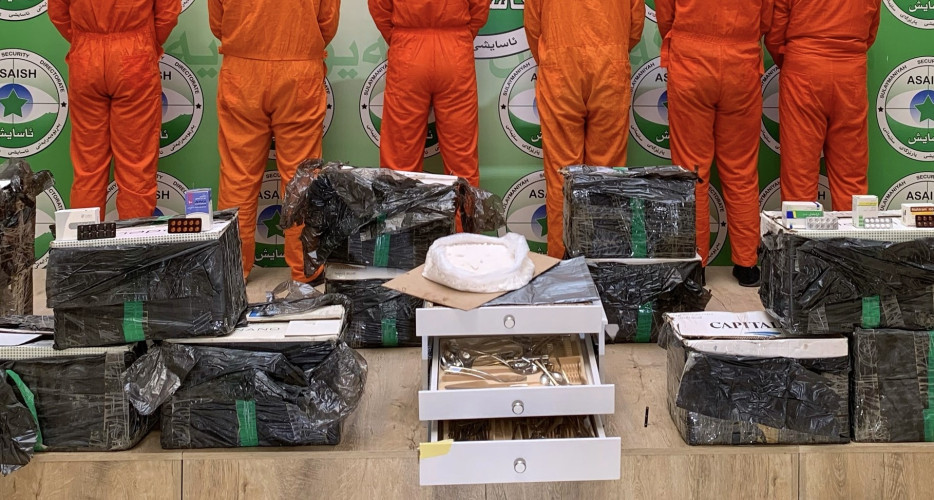
In 2025 alone, the number of detainees held on drug-related charges in the Kurdistan Region reached 2,713 individuals. According to the latest statistics from the Asayish (Security) Agency, that number exceeded 1,100 the previous year. The ages of the accused range between 18 and 60, with the vast majority—96 percent—being male, and the remainder female.
The most dangerous types of narcotics in the Kurdistan Region include opium, heroin, crystal meth, marijuana, Jamaica, hashish, cocaine, and several others. However, the most prevalent is "crystal," known locally as "Shisha."
"Shisha" affects the brain directly within three minutes and is known as a pathogen that causes the decay of brain cells.
In the past year, two tons, 128 kilograms, and 262 grams of narcotics were seized in the Kurdistan Region, along with three tons and 668 kilograms of chemical acids, according to Asayish Agency operations, which also resulted in the seizure of dozens of weapons and vehicles.
According to statistics from the Iraqi Ministry of Interior, the situation there is no better; more than 21,000 arrest warrants were executed in 2025, over 21,000 sentences were handed down to drug traffickers, and more than 1,200 drug gangs and networks were dismantled.
A Relentless Grip on Youth
Asrin has spoken to her husband twice by telephone. He is remorseful. When she asked why he turned to drugs, he replied, "To obtain a sum of money to improve our lives." However, that justification did not change their lives; rather, it destroyed them completely. As Asrin says, "He devastated our entire lives; by the time he is released from prison, my children will be grown and teenagers."
Her husband’s remorse does nothing to alter the family's circumstances. Asrin, deeply angered by the consequences of the event, said: "My children and I must pay the price for his mistake until the end of our lives."
Those who use or traffic narcotics are mostly young, similar to Asrin’s husband. According to statistics from the Directorate for Combating Drugs in the Kurdistan Region, 82 percent of drug users and traffickers are between the ages of 18 and 40. Those under 18 account for 1 percent, while those over 40 make up 17 percent. Females across all age groups represent 4 percent of the total.
The causes of addiction are numerous, and social researchers emphasize several key factors: lack of self-confidence, bad company, poor social standing, low income, poor family upbringing, low awareness, unemployment, mental illness, escaping from problem-solving, and the use of violence in upbringing.
Sana Mohammed, a social researcher, told Peregraf: "The spread of narcotics and the increasing number of addicts pose a threat to social security, as it leads to the destruction of the individual, who is the primary force in building the family and society.
The Three Dangerous Stages
According to psychological experts and specialists, every drug addict passes through three stages. It begins with learning (experimentation), followed by the stage of habituation, and when they find themselves unable to quit, they are in the most dangerous stage: addiction. Such was the case for Kamaran.
Kamaran is the pseudonym of a young man in Kirkuk who was previously addicted to narcotics and received treatment after his arrest. "During my outings with a group of friends, I learned how to use drugs. I became addicted and would do anything to obtain them." When he says he would do anything, it sometimes reached the point of selling all his household furniture to acquire drugs. "When I had nothing left, I would take money from my mother to buy them."
Narcotics include all raw and prepared substances that possess stimulant or analgesic properties and are used outside of beneficial medical and industrial fields; the individual becomes addicted, causing physical and psychological harm to both the individual and society.
"Due to narcotics, my behavior changed significantly; I became a depressed and paranoid person. I even mistrusted my own mother and created problems for my household," Kamaran said. Suddenly, one night, he fell into the hands of the National Security forces, marking the start of another story of misery, this time for those around him.
"I lost my family. Even though I have quit, people still look at me in the same old way, and many do not trust me."
Narcotics come in many forms; some share similar characteristics, while others differ greatly. Natural ones are derived directly from plants, such as hashish, opium, coca, and khat. Refined ones are extracted from natural substances and plants, including morphine. Synthetic chemical drugs are substances produced through chemical reactions that have passed through all stages of manufacturing in a laboratory, such as amphetamines, barbiturates, and Captagon.
Saman Sardar, a psychological specialist, told Peregraf: "Most people whose family structures have collapsed and who grew up in fragmented families, or those who are unemployed and have economic or social problems, feel forced to resort to things that distance them from the psychological pressure they are under."
He cited an example: they resort to smoking cigarettes or progress to hookah, which is a more dangerous stage because "those who smoke it describe feeling pleasure and a kind of self-forgetfulness. This leads to addiction, and most of them proceed to further stages of drug use."
Saman also proposed an immediate remedy: anyone suffering from unemployment, emotional voids, or other problems can turn to reading and sports.
The Weakness of the Response
The negative effects of narcotics are so profound they are often referred to as the "White Plague," and the consequences worsen when an addict is mixed with other criminals in prison instead of receiving clinical treatment.
Peshraw Qadir, a specialist in internal medicine, told Peregraf: "Drug victims must be treated as victims or patients and should be treated quickly so they do not become chronic addicts." He further explained that some individuals became involved with drugs unknowingly or used them for experimentation, but they do not seek medical help out of fear of arrest and social stigma.
According to statistics from the Iraqi Ministry of Interior, approximately 6,000 drug addicts have been treated and recovered through treatment centers in several provinces. Kamaran is one of the beneficiaries.
During two years of imprisonment, Kamaran received treatment at the drug addict rehabilitation center in Kirkuk. "After my release, I changed my telephone number and do not go near the people who were previously my friends. I work now and will never use drugs again."
In contrast to Iraq, which has 16 treatment centers and has trained dozens of instructors for the process, the Kurdistan Region has no official rehabilitation facility for drug addicts.
Arkan Omer, spokesperson for the Directorate for Combating Drugs in the Kurdistan Region, told Peregraf that the foundation stone for a rehabilitation center covering an area of 13,000 square meters has been laid in Erbil Province. Work is ongoing, and it is being built by the Barzani Charity Foundation and an international organization.
The lack of rehabilitation centers for drug users is seen as a major risk for the continued use and spread of narcotics.
"The psychological damages to addicts are far greater than the physical damages because these individuals lose their dignity and suffer from intense psychological pressure. They remain in a constant state of anger, agitation, or fear, losing trust in those around them," the psychological specialist said. He added that when an addict is arrested, their condition often worsens: "They must be sent to specialized treatment centers... so they can be rehabilitated and reintegrated into society."
The Law: Punishment and Supervision
The use of and trafficking in narcotics carries heavy penalties. The Law on Combating Narcotics and Psychotropic Substances in the Kurdistan Region, No. 1 of 2020, stipulates: if a person exports, imports, manufactures, cultivates, or trades in narcotics or their seeds, they shall be sentenced to death or life imprisonment.
The penalties are not limited to imprisonment; trafficking also carries financial fines. Any person who has acquired, traded, or mediated in the sale of narcotics, psychotropic substances, or chemical precursors—or who has provided a place for their use—shall be punished with life or temporary imprisonment and a fine ranging from 30 to 90 million Dinars.
Even after serving their sentences, drug victims remain under supervision.
The spokesperson for the Directorate for Combating Drugs said: "Those who are released are summoned periodically and subjected to testing to ensure they have not returned to drug use. If a test reveals they have relapsed, legal measures are taken and they are punished again."
Among the drug detainees are foreign nationals. After their trials and the completion of their sentences, they are deported to their home countries, according to Arkan Omer.
The law also addresses pharmaceutical addiction, stating that—except for legitimate medical purposes and according to strict ministry guidelines—a physician may not prescribe narcotics or psychotropic substances for any patient.
Between Awareness and Treatment
The danger of narcotics requires continuous public awareness as much as it requires medical facilities.
"The treatment of drug users is primarily physical. Unfortunately, in no hospital in Iraq or the Kurdistan Region do we have the specific testing reagents required to determine exactly which drug the person is addicted to, which is necessary to properly detoxify them," said Peshraw Qadir.
Addicts "rarely" seek specialist doctors of their own accord; most dare not due to social stigma, though some are taken to hospitals as emergency cases due to overdose. The specialist added: "Unfortunately, there have been deaths of addicts in hospitals among both genders."
The consequences of addiction range from a decrease in public security and an increase in crime to rising violence and family collapse.
Sana Mohammed emphasized the need for relevant authorities to identify the causes of addiction scientifically and through research to find fundamental solutions. Another way to reduce addiction, she stated, is the continuation of awareness campaigns regarding the dangers of narcotics, prevention strategies, and the clarification of legal penalties.
Grieved and sorrowful, nothing but lamentation escapes Asrin's lips. "I have been unfortunate since childhood; due to the absence of a mother, I had neither a childhood nor a youth. I was 15 years old when I married to escape a stepmother. I spent eight years in poverty with my husband and was grateful, but he brought disaster upon himself and us," she said.