PUK Insists on Interior Ministry Position as KDP Talks Resume Amid Prolonged Stalemate
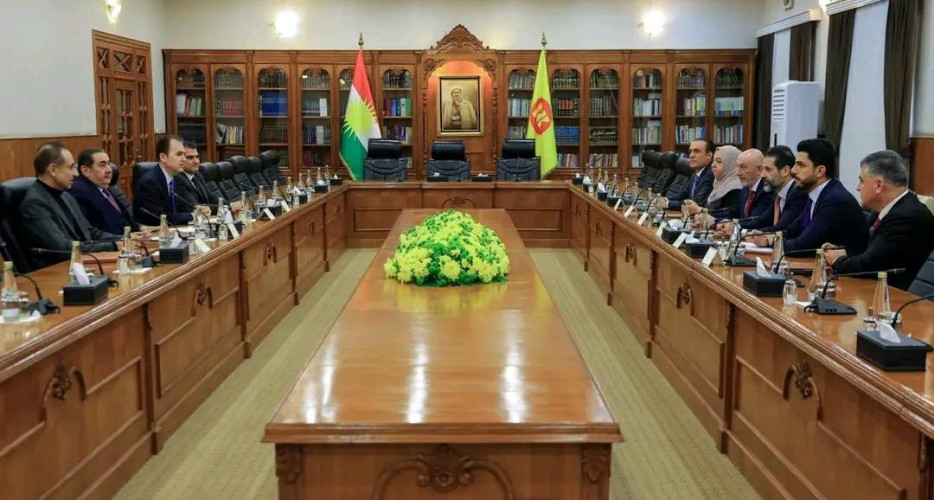
Peregraf — Two days after renewed talks between the Kurdistan Democratic Party (KDP) and the Patriotic Union of Kurdistan (PUK) on forming a new government in Kurdistan Region, the PUK has made clear it will not retreat from its core demands, particularly its claim to the Post of Ministry of Interior in the upcoming cabinet of Kurdistan Regional Government (KRG).
In his first official comments following the latest meeting, PUK spokesperson Kawan Gaznayi described the talks as "not bad," saying they helped lay the groundwork for future negotiations. However, he stressed that the party’s position on key posts remains unchanged.
Speaking at a press conference, Gaznayi said the PUK seeks to be a "real and effective partner" in governance. Referring to the Ministry of Interior — the most contentious issue between the two ruling parties — he stated, "The PUK will not compromise on its negotiation paper, nor on the positions it considers its electoral right."
The KRG Interior Ministry has long been a central point of dispute in KDP–PUK negotiations, as it oversees security forces and internal administration. While the PUK insists the post reflects its electoral weight and political entitlement, the KDP has so far refused to relinquish it, contributing to months of deadlock in government formation talks.
Gaznayi also addressed the issue of Iraq’s presidency, saying the PUK has not yet named a candidate but will put forward a nominee for the post. "The PUK will have a candidate for the position of President of Iraq," he said, without providing further details.
Talks Resumed After Months of Deadlock
Negotiations between the two parties resumed on the 16th of this month, with the PUK delegation led by PUK senior leader KRG Deputy Prime Minister Qubad Talabani and the KDP delegation headed by senior figure Hoshyar Zebari. The talks focus on forming the tenth KRG cabinet as well as coordinating positions ahead of the formation of Iraq’s next federal government.
The renewed dialogue comes more than a year and two months after elections were held for the sixth term of the Kurdistan Parliament. Despite the passage of time, the Kurdistan Region remains without a fully formed government, and parliament has been effectively stalled.
Although the newly elected Kurdistan parliament convened for its first session in December 2024, it has been unable to meet again. The election of a parliamentary presidium requires consensus between the KDP and the PUK, which has so far proved elusive due to disputes over power-sharing and key posts.
Baghdad Moves Faster Than Erbil
While political paralysis continues in Erbil, developments in Baghdad have moved at a much faster pace. The Shiite Coordination Framework has declared itself the largest bloc in the Iraqi parliament, claiming more than 170 seats, and has begun preparations to nominate Iraq’s next prime minister.
Shortly afterward, Sunni political forces announced the formation of the National Political Council, uniting parties that collectively hold more than 70 seats. The council aims to negotiate as a single bloc to secure shared political and constitutional demands.
By contrast, Kurdish parties remain divided, with no unified position on whether they will enter federal negotiations as a single bloc or as separate groups. Political observers warn that this fragmentation significantly weakens Kurdish leverage in Baghdad and risks undermining the Kurdistan Region’s political and constitutional gains.
In Iraq’s sixth parliamentary elections, Kurdish parties secured a combined total of 58 seats, in addition to five minority quota seats aligned with the KDP. The distribution of seats stands at: KDP with 27 seats plus five quota seats, PUK with 18, Halwest with five, the Kurdistan Islamic Union (KIU) with four, New Generation with three, and Komal with one.
Year-Long Stalemate in Erbil
More than a year after voters went to the polls in the Kurdistan Region, the ongoing standoff between the KDP and the PUK has not only delayed the formation of the tenth KRG cabinet but is increasingly threatening to marginalize Kurdish influence at the federal level.
Disputes over the distribution of key posts — particularly security-related positions and the Interior Ministry — have paralyzed political life in the Region. Without agreement between the two dominant parties, neither the government nor parliament can function effectively, leaving the KRG without a fully empowered executive at a critical political moment.
Election Results and Political Landscape
In the Kurdistan parliamentary elections held on October 20, 2024, the KDP emerged as the largest party with 39 seats, followed by the PUK with 23. New Generation secured 15 seats, the KIU won seven, while the remaining seats were divided among smaller parties and minority representatives. Of the five minority quota seats, three are aligned with the KDP and two with the PUK.
The legitimacy of the elections has been contested by several parties. Seven opposition groups — excluding New Generation — have rejected the results, alleging fraud. The Kurdistan Justice Group (Komal) has announced a boycott of the entire parliamentary term. However, the Independent High Electoral Commission of Iraq (IHEC) has dismissed all fraud allegations.
This rejection has further complicated government formation, as political pressure and public skepticism discourage some parties from joining a new cabinet.
Coalition Still the Only Viable Path
Despite rising tensions and prolonged negotiations, most analysts agree that a coalition government between the KDP and the PUK remains the most realistic option for forming the tenth KRG cabinet. Together, the two parties control 67 seats when minority allies are included, with the KDP holding 42 seats and the PUK 25.
In practical terms, neither party can govern alone. Most other political forces have either rejected the election results or positioned themselves in opposition, leaving New Generation as the only actor capable of significantly shifting the balance of power if it chooses to side decisively with one camp.
For now, the fate of the next Kurdistan Regional Government remains uncertain. It depends largely on whether the KDP and the PUK can bridge their differences — particularly over the Interior Ministry — and whether New Generation will use its pivotal position to help end the political deadlock or attempt to reshape the next government on its own terms.