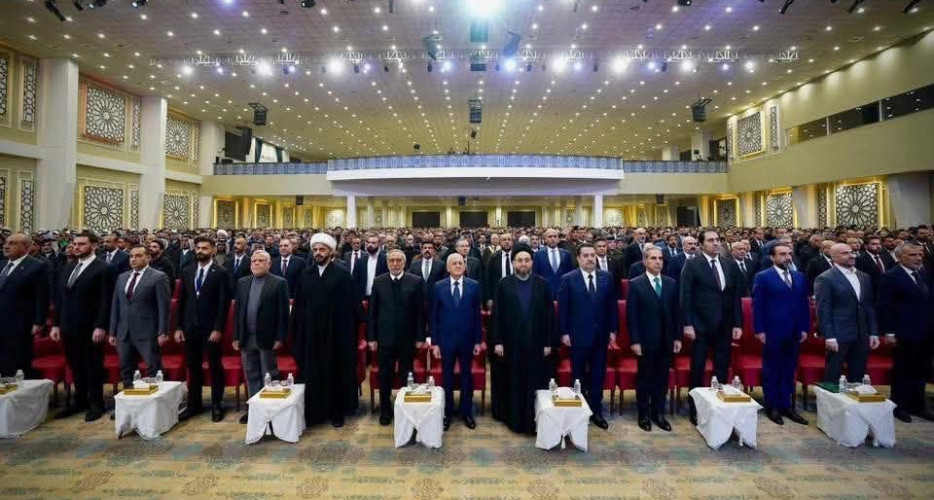
Peregraf - Iraq’s President, Prime Minister, and Speaker of Parliament on Saturday issued coordinated calls to accelerate the formation of the next federal government, stressing inclusivity, respect for constitutional deadlines, and the preservation of national stability following the ratification of the 2025 parliamentary election results.
Speaking at the official memorial ceremony marking the anniversary of the martyrdom of Grand Ayatollah Sayyid Mohammed Baqir al-Hakim, President Abdul Latif Jamal Rashid urged the formation of a government that represents all components of Iraqi society and advances the process of state-building.
“The formation of the next government must ensure the representation of all Iraqis in order to advance the development of the state,” Rashid said, recalling the legacy of al-Hakim as a prominent religious and national figure who opposed dictatorship. He emphasized the moral and national duty to honor the sacrifices of martyrs, scholars, and major national figures and to pass their stories to future generations.
The President also highlighted Iraqi Martyr’s Day as a reminder of the sacrifices made by the Iraqi people and security forces, including the Army, Police, Popular Mobilization Forces (PMF), and the Peshmerga. He noted that Iraq has emerged from years of tyranny, violence, and terrorism to reach a level of security and stability that must be safeguarded through collective responsibility.
On the same occasion, Prime Minister Mohammed Shia’ al-Sudani called on national political forces to move forward with resolving constitutional entitlements and completing the government formation process. Addressing attendees at the memorial ceremony organized by the National Wisdom Movement (Al-Hikma) in Baghdad, al-Sudani said voter turnout in the elections reflected public confidence in the government’s performance and its “Iraq First” state-building approach.
“Active electoral participation represented a significant turning point upon which we will build the features of the next stage to consolidate the democratic path,” the Prime Minister said, urging political forces to act in accordance with their responsibility toward the country’s supreme interests. He added that while progress has been made in development, “there is still more ahead of us.”
Speaker of Parliament Mahmoud al-Mashhadani also stressed the urgency of expediting the formation of the government and adhering to constitutional timelines. “In order to preserve the national achievements realized through the blood of the martyrs, it is imperative to speed up the formation of the government and respect the deadlines stipulated by the Constitution,” he said during the ceremony.
Earlier this month, President Rashid issued a presidential decree on December 16 inviting members of the newly elected Council of Representatives to convene their first session on December 29, 2025, following the Federal Supreme Court’s ratification of the final election results on December 14. The ratification formally triggered the constitutional timelines for forming the next government.
According to constitutional provisions outlined by the Supreme Judicial Council, parliament must elect the Speaker of the Council of Representatives and two deputies within 15 days of ratification. These positions are chosen by an absolute majority during the first session, which is chaired by the oldest member and includes lawmakers taking the constitutional oath. The Speaker’s post is traditionally allocated to the Sunni component, with Sunni political forces currently consulting to agree on a consensus candidate.
Within 30 days of electing the Speaker and deputies, parliament must elect the President of the Republic by a two-thirds majority—220 votes in the 329-seat legislature. The elected President then has 15 days to task a prime ministerial nominee with forming a government, after which the designated prime minister has up to 90 days to present a cabinet to parliament for a vote of confidence.
Final election results show the Construction and Development Coalition, led by Prime Minister al-Sudani, winning the largest bloc with 46 seats. The State of Law Coalition, led by Nouri al-Maliki, followed with 29 seats, while Taqaddum and the Kurdistan Democratic Party (KDP) each secured 27 seats, and the Patriotic Union of Kurdistan (PUK) won 18 seats. Nationwide voter turnout reached 56.11 percent.
Prior to the court’s ratification, the Shiite Coordination Framework announced it had formed the largest parliamentary bloc and reaffirmed its intention to proceed with nominating the next prime minister, emphasizing national cooperation and strict adherence to constitutional timelines to ensure a smooth transition of power.