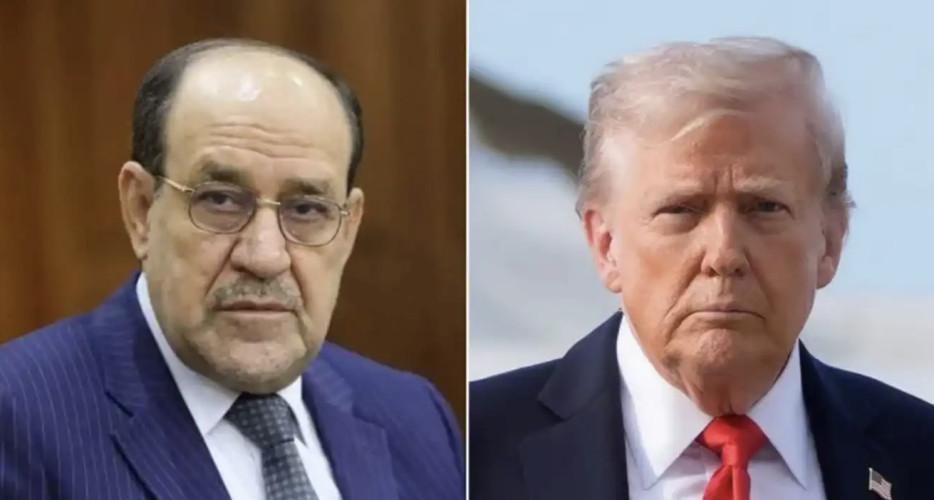
Peregraf — Former Iraqi Prime Minister Nouri al-Maliki has responded to sharp criticism from U.S. President Donald Trump, stressing respect for Iraq’s national will and rejecting what his party described as foreign interference in the country’s internal affairs.
In a statement following Trump’s remarks, al-Maliki said he would continue his political efforts in line with the decision of Iraq’s Coordination Framework, which recently nominated him as its candidate for prime minister. “Out of respect for the national will and the decision of the Coordination Framework, I will continue to work until we reach the end, in a manner that achieves the supreme interests of the Iraqi people,” al-Maliki said.
The Islamic Dawa Party, led by al-Maliki, issued a separate statement emphasizing Iraq’s sovereignty and independence. The party said that respecting Iraq’s political process requires “respecting the political choice of its people and denouncing interference from any party or country in its internal affairs.”
The response comes a day after U.S. President Donald Trump issued a strong warning against al-Maliki’s potential return to power. In a statement, Trump said he was hearing that Iraq “might make a very bad choice by reinstalling Nouri al-Maliki as Prime Minister,” arguing that during al-Maliki’s previous term the country “descended into poverty and total chaos.”
Trump warned that if al-Maliki were to return to office, the United States would withdraw its support for Iraq. He said that because of al-Maliki’s “policies and ideologies,” Iraq would have “ZERO chance of success, prosperity, or freedom” without U.S. backing, ending his remarks with the slogan “MAKE IRAQ GREAT AGAIN!”
Trump’s comments came amid ongoing negotiations in Baghdad over the formation of a new government following Iraq’s elections.
On January 24, Iraq’s Coordination Framework announced that it had officially nominated al-Maliki as its candidate for prime minister after an expanded leadership meeting held at the office of Hadi al-Amiri. The alliance said the nomination was approved by a majority vote, citing al-Maliki’s political and administrative experience, and reaffirmed its commitment to the constitutional process.
Al-Maliki served as Iraq’s prime minister from 2006 to 2014, a period marked by political polarization, mass protests, and severe security challenges, including the rise of ISIS. His possible return remains highly controversial within Iraq and has drawn renewed international attention.
The exchange highlights growing tension between Iraqi political forces and international actors as Iraq approaches a decisive phase in forming its next government amid economic pressures, security concerns, and regional instability.