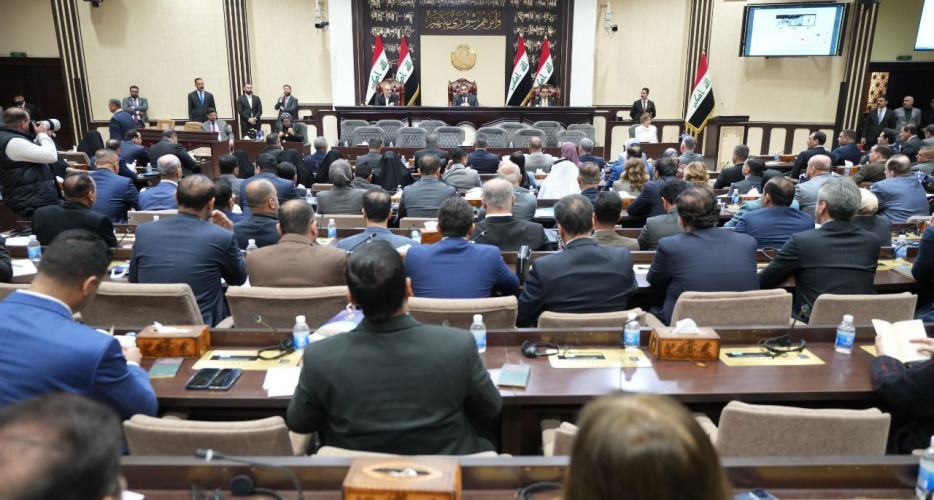
Peregraf — Despite being scheduled for today and marking the final constitutional deadline, the Iraqi Parliament session to elect the President "will not be held", according to Peregraf’s follow-up. The postponement is due to ongoing internal disputes within both the Kurdish and Shiite political camps, as well as U.S. President Donald Trump’s rejection of Nouri al-Maliki as a candidate for prime minister.
A high-level informed source in Baghdad told Peregraf that the Kurdistan Democratic Party (KDP) and the Patriotic Union of Kurdistan (PUK) have failed to reach an agreement on a joint presidential candidate, a post constitutionally allocated to the Kurds. At the same time, Shiite political forces—despite facing internal disagreements over the premiership—have placed responsibility on the Kurdish parties, stating that if either the KDP or PUK boycotts the session, Shiite blocs will also refrain from attending.
According to the source, without a prior agreement between the two main Kurdish parties—or a broader understanding between the Kurds and Shiite forces, which hold a parliamentary majority—the required quorum will not be met and “the session will not be held today.”
The source added that had the Shiite parties not been divided over the prime ministerial nominee, the session would likely have proceeded and the President elected today. However, the political process has stalled, as the election of the President must be immediately followed by the nomination of a prime minister to form the next government.
“The Shiite house is currently in a state of political complexity,” the source said. “Replacing Maliki is viewed by some as a failure or humiliation, yet keeping him poses a serious problem for Iraq. Following Trump’s rejection, Iraq could face a major crisis if the United States refuses to engage with the next government.”
In a related development, Kurdistan Region Prime Minister Masrour Barzani told reporters on Saturday that no agreement has yet been reached. He said Erbil is awaiting the arrival of a delegation from the Shiite Coordination Framework to discuss both the presidential and prime ministerial.
According to Parliament’s official agenda, the session was scheduled to begin at 11:00 a.m., but more than an hour passed without proceedings starting.
The presidential election session was previously postponed on Tuesday, January 27, 2026, at the request of the KDP and PUK blocs to allow additional time to reach a joint agreement—an insistence also echoed by Shiite parties.
Meanwhile, Iraq’s Supreme Judicial Council reiterated the necessity of full adherence to constitutional deadlines for electing the President and appointing the Prime Minister, warning that any deviation could threaten political stability and the democratic process in the country.
Meanwhile, Iraq’s Shia Coordination Framework on Saturday reaffirmed its commitment to nominating Nouri Kamil al-Maliki for the post of prime minister, despite a public rejection by former U.S. President Donald Trump.
In a statement issued after its 261st regular meeting, held at al-Maliki’s office on January 31, 2026, the Framework said the selection of the prime minister is a purely Iraqi constitutional matter, conducted in accordance with political mechanisms and national interests, and free from external interference.
The bloc stressed its intention to maintain balanced relations with the international community, particularly influential global powers, on the basis of mutual respect and non-interference in Iraq’s internal affairs. It also underlined that Iraq is a state of institutions capable of managing its constitutional entitlements in line with the will of elected representatives, while calling on all political forces to respect constitutional timelines and intensify efforts to reach consensual solutions.
According to Iraqi media, Ammar al-Hakim did not participate in the meeting.
Earlier, ahead of the session, al-Hakim—head of the National State Powers Alliance, which is part of the Coordination Framework—expressed deep regret over Trump’s tweet rejecting al-Maliki’s nomination. He emphasized the need to uphold constitutional deadlines and prioritize Iraq’s national interests.
In a statement, al-Hakim stressed “the importance of adhering to constitutional timings,” calling for the election of the President of the Republic and the pursuit of appropriate solutions to the current political impasse. He warned that escalating tensions could lead to significant economic consequences, while reaffirming pride in positions that safeguard Iraq’s sovereignty, describing such approaches as “the height of courage and responsibility.”
Al-Hakim further clarified that the Hikma National Movement does not seek opposition, obstruction, or political pressure, noting that its stance on participation or non-participation in the political process is determined solely by what best serves the public interest.