Kurdistan Presidency and U.S. Reaffirm Commitment to Peshmerga Reform Amid Persistent Challenges
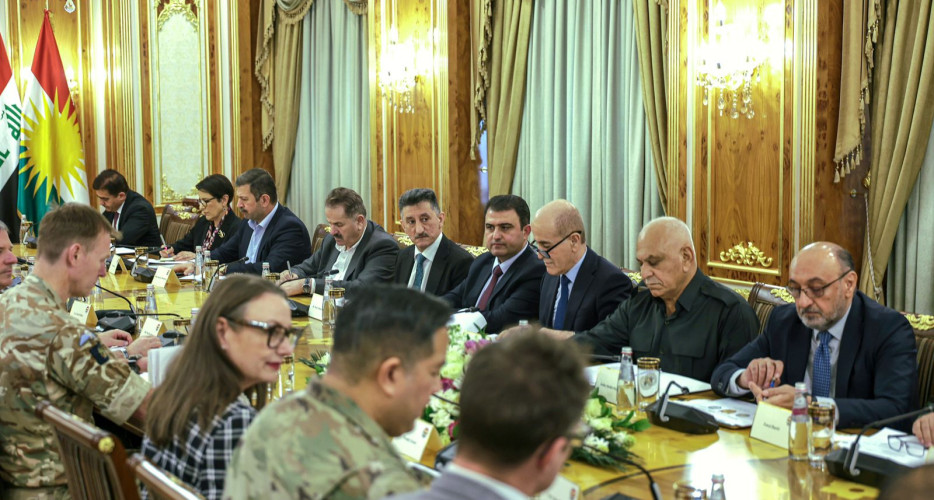
Peregraf - The Presidency of the Kurdistan Region announced that senior officials and a U.S. diplomatic and military delegation have reaffirmed their commitment to accelerating the Peshmerga reform process. The meeting underscored a renewed momentum to address looming challenges and reinvigorate long-stalled unification efforts.
The latest round of talks, held today at the Kurdistan Region Presidency, brought together representatives from relevant regional institutions and a visiting U.S. delegation. The meeting was attended by Kurdistan Region Vice President Jaafar Sheikh Mustafa and U.S. Consul General in the Kurdistan Region, Wendy Green.
According to a statement issued by the Presidency, participants emphasized the necessity of ensuring the success of the Peshmerga reform process and reviewed the latest steps undertaken.
"The meeting also reaffirmed joint measures to accelerate the process and address the challenges ahead, while views were exchanged on expanding coordination and cooperation between the two sides," the Presidency stated.
Reform Roadmap Under Strain
The renewed pledge comes against a backdrop of mounting concerns in Washington regarding the slow pace of implementation.
A July 2025 report by the U.S. Department of State’s Office of Inspector General warned that political rivalries, financial constraints, and stalled integration are undermining progress. U.S. officials noted that, despite formal commitments, Peshmerga units remain largely fragmented along party lines, limiting the effectiveness of reform efforts.
At the heart of the process is the 2022 Memorandum of Understanding (MoU) signed between the United States and the Kurdistan Regional Government (KRG). The agreement established a four-year roadmap aimed at integrating partisan forces—specifically Unit 80, affiliated with the Kurdistan Democratic Party (KDP), and Unit 70, affiliated with the Patriotic Union of Kurdistan (PUK)—into a unified, non-partisan structure under the Ministry of Peshmerga Affairs.
The objective is to consolidate command and control within a professional military institution, thereby reducing party influence and strengthening accountability. However, the Inspector General’s report concluded that "despite formal commitments, Peshmerga units remain fragmented along party lines, with little meaningful progress toward true unification."
Conditional Support and Political Realities
Since 2016, the United States and its European coalition partners have provided extensive training, funding, and equipment to professionalize the Peshmerga forces, particularly for the fight against ISIS. Yet, coalition assistance is conditional; financial stipends and material support are strictly limited to non-partisan brigades that have been formally transferred to the Ministry of Peshmerga Affairs.
Analysts suggest the longstanding rivalry between the KDP and PUK remains the core structural obstacle. Both parties continue to maintain significant control over their affiliated units, effectively weakening the authority of the Ministry and complicating institutional reform.
The U.S. report stressed that reforming the Peshmerga cannot be isolated from broader changes within Kurdistan’s internal security architecture. "It’s not enough to focus solely on the Peshmerga," the report noted, warning that broader reform of internal security forces and the cessation of party control are essential for long-term stability.
Renewed Commitments, Lingering Questions
Wednesday’s meeting signals a shared intent to reinvigorate the reform agenda. By reaffirming joint steps to accelerate the process and tackle existing obstacles, both sides appear keen to project forward movement.
However, observers caution that technical coordination alone will not be sufficient. Without sustained political will from both dominant parties, deeper structural integration may remain elusive.