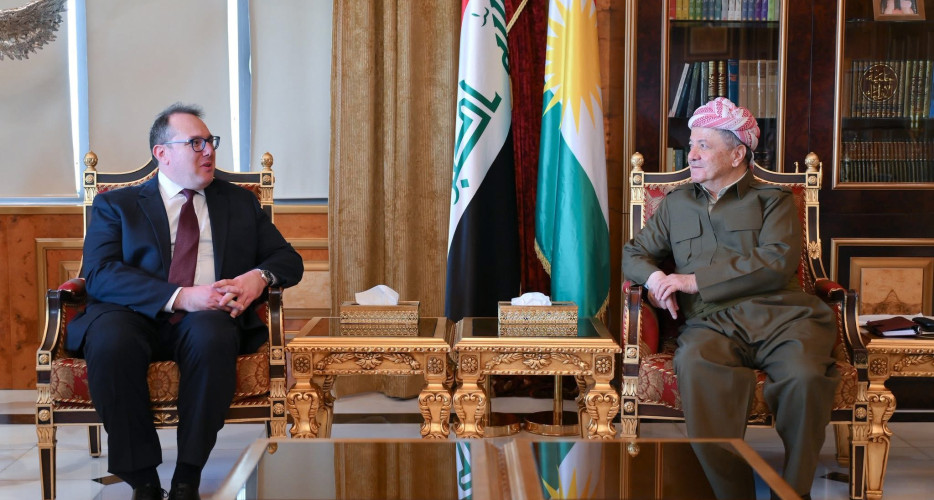
Peregraf — As Iraq’s political impasse drags on with no agreement on a new president or cabinet, senior Kurdish and American officials on Wednesday stressed the need for an independent and sovereign Iraq, amid former Prime Minister Nouri al-Maliki faces firm opposition from U.S. President Donald Trump over his perceived closeness to Iran.
At his office in Pirmam, Masoud Barzani, President of the Kurdistan Democratic Party (KDP), received Joshua Harris, the Chargé d’Affaires of the U.S. Embassy in Iraq, for talks that underscored Washington’s strategic vision for Iraq and the Kurdistan Region.
U.S. Backs Kurdistan Within Federal Iraq
According to a statement released after the meeting, Harris reaffirmed U.S. support for the Kurdistan Region within the framework of a federal Iraq. He emphasized Washington’s desire to maintain and deepen its strategic partnership with both Baghdad and Erbil.
Central to the American message, officials said, was the necessity for Iraq to safeguard its sovereign decision-making and prioritize its national interests above external pressures — a pointed reference, political observers noted, to Tehran’s influence in Iraqi politics.
The U.S. diplomat stressed that an independent Iraq, capable of making decisions free from regional interference, would be better positioned to strengthen ties with Washington and the broader international community.
Trump Reportedly Rejects Maliki
The meeting comes as Iraq remains locked in political deadlock following months of stalled negotiations to elect a new president and form a government cabinet. Rival blocs have yet to reach consensus, with disputes centering on the premiership and the distribution of key posts.
Trump has privately and publicly rejected the possibility of Maliki returning as prime minister, arguing that the veteran Shiite leader is too closely aligned with Iran. Maliki, who heads the State of Law Coalition, has dismissed such reports as external interference and insisted that Iraq’s leadership must be decided internally.
The reported U.S. position has added a new layer of complexity to negotiations, particularly among Shiite factions divided over whether Maliki remains a viable candidate amid growing regional tensions.
Barzani: Constitution, Partnership, and Balance
Barzani, for his part, underscored the importance of adhering to Iraq’s Constitution and preserving what he described as the foundational principles of partnership, balance, and consensus between Baghdad and the Kurdistan Region.
He stressed that these principles must guide the formation of the upcoming Iraqi government, warning that sidelining any major component would risk deepening divisions.
Barzani also called for the full implementation of constitutional provisions related to the Kurdistan Region, particularly in regard to budget allocations and unresolved disputes between Erbil and Baghdad. Kurdish officials have long accused the federal government of unfair financial measures that disproportionately affect the people of Kurdistan.
In addition, Barzani emphasized the need for Iraq to maintain balanced relations with its neighbors while ensuring that its decisions remain independent and reflective of national — not foreign — priorities.
Deadlock Over Presidency and Cabinet
Under Iraq’s political system, parliament must first elect a president, who then formally tasks the largest parliamentary bloc with forming a government. However, divisions among Kurdish parties over the presidency and among Shiite blocs over the premiership have stalled progress.
The ongoing impasse has raised concerns about institutional paralysis at a time when Iraq faces mounting economic pressures, security challenges, and regional instability, particularly amid developments in Syria and broader Middle Eastern tensions.
During Wednesday’s meeting, Barzani and Harris also discussed the situation in Syria and internal political developments within the Kurdistan Region, though officials did not provide details.