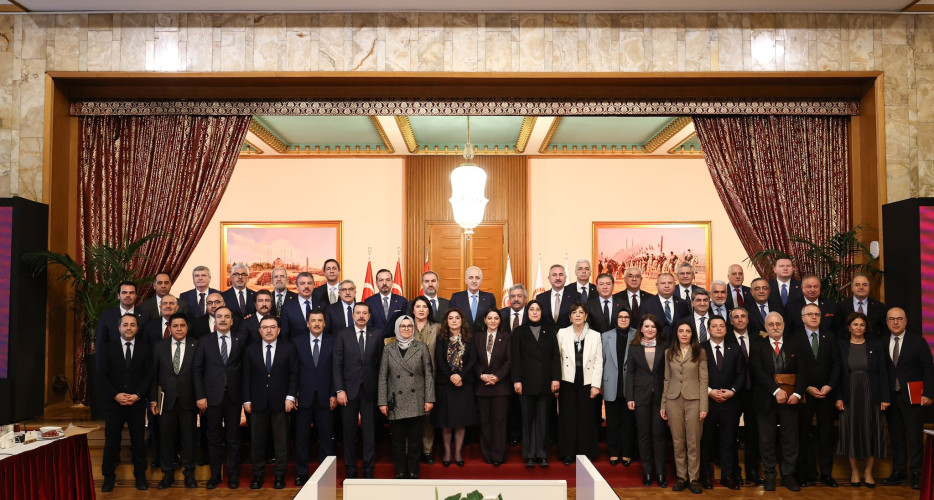
Peregraf- The Turkish Parliament’s special commission tasked with addressing the Kurdish question has finalized and approved its long-awaited report, marking a significant step in the country’s efforts to resolve the decades-long conflict. The report, compiled over 88 working hours and spanning 4,199 pages of minutes, is now set to form the foundation for future policy discussions.
Numan Kurtulmuş, Speaker of the Turkish Parliament, described the Kurdish issue primarily as a “terrorism issue” and clarified during the session, “This report does not constitute an amnesty.” He outlined that while a formal constitutional amendment was not part of the commission’s mandate, it remains a critical step for a lasting resolution.
Report Overview
The commission, officially named the National Solidarity, Brotherhood, and Democracy Commission, structured its report into seven main sections:
1. Commission Research – documenting the work process of the commission.
2. Objectives – highlighting the primary goals of the initiative.
3. Historical Context – exploring the roots of Turk-Kurd relations and shared historical foundations.
4. Consensus Areas – summarizing common ground drawn from interviews with experts, officials, and civil society actors.
5. Disarmament – focusing on proposals for the dissolution of the Kurdistan Workers’ Party (PKK) and related security measures.
6. Legal Framework – proposing legislative changes to support the process.
7. Democratization – outlining measures to strengthen political inclusion and minority rights.
The report also includes five appendices, detailing commission membership, working principles, digital records submitted by political parties, summaries of 20 meetings, and a list of institutions and individuals providing testimony.
Constitutional Reform Still Needed
While the report emphasizes legislative solutions, experts note that lasting resolution of the Kurdish issue will require fundamental constitutional amendments. Kurtulmuş acknowledged this need, stating, “Although drafting a new constitution is not within the scope of this commission’s duties, it stands before us as a shared responsibility that cannot be delayed and must be implemented for our country.”
Kurdish Representatives Voice Reservations
Kurdish lawmakers within the commission, represented by the DEM Party, expressed concerns over key terms and definitions used in the report. In a formal statement, DEM Party members criticized references to the “Terror-Free Turkey Process” and labels such as “terrorist organization,” arguing that these terms fail to reflect the multiethnic reality of Turkey, home to Kurds, Turks, Arabs, and other groups.
The party called for:
• Recognition of the process as the “Peace and Democratic Society Process,” reflecting Abdullah Öcalan’s February 27 statement.
• Consideration of alternative terminology, such as “Democracy, Brotherhood, and National Unity,” to reflect consensus-building rather than security-focused language.
• Acknowledgment of Öcalan as a central actor in the process.
• Guarantees for mother-tongue education and the formal recognition of multilingualism, ensuring Kurdish and other languages are legally protected.
The approval of the report marks a procedural milestone, but debates over language, terminology, and constitutional reform underscore the challenges ahead. Analysts suggest that while the report sets a roadmap, its implementation will require both political will and broad societal consensus to achieve a durable resolution.