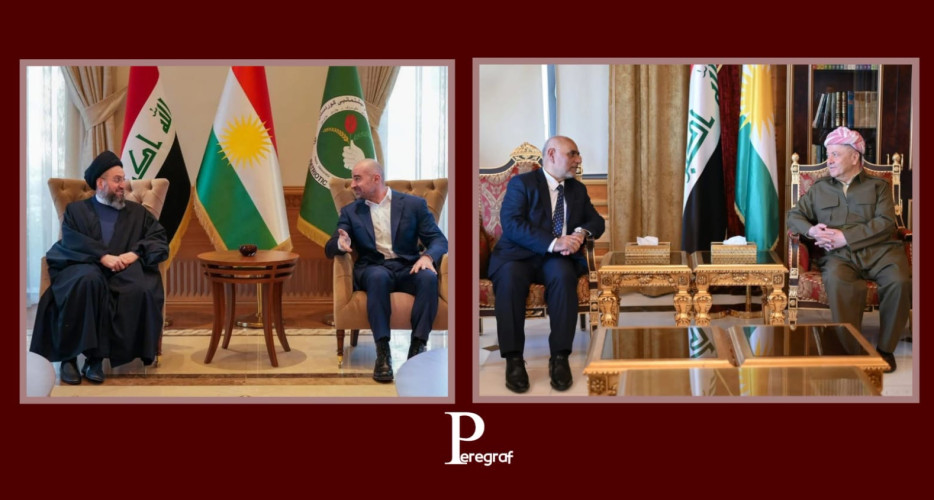
Peregraf - Iraq’s leading political figures intensified calls on Saturday, February 21, to accelerate the election of a president and prime minister, projecting urgency and readiness in public statements even as tangible progress on the ground remained elusive.
The day’s most closely watched development was a series of parallel, high-level meetings involving Kurdish and Shiite leaders. The talks underscored renewed efforts to break months of political paralysis following the November 2025 elections, but they also revealed the limits of those efforts.
In Pirmam, Masoud Barzani, head of the Kurdistan Democratic Party (KDP), hosted a senior delegation from the Islamic Dawa Party led by Nouri al-Maliki. According to statements released after the meeting, both sides emphasized the need to expedite constitutional procedures, including the election of a president and the formation of a new cabinet.
The Dawa delegation stressed the importance of forming what it described as a “strong and capable government,” signaling alignment with broader calls across Iraq’s political spectrum to end the prolonged political vacuum.
At the same time in Baghdad, Bafel Talabani, leader of the Patriotic Union of Kurdistan (PUK), met with Ammar al-Hakim of the Hikma Movement. Talabani reiterated his party’s readiness to attend a parliamentary session to elect a president—a post traditionally held by a Kurdish figure and claimed by the PUK as its political right.
In official statements, both Kurdish and Shiite actors converged around a single message: the process must move forward quickly.
Yet despite this apparent consensus, the political reality remains unchanged.
Consensus in Words, Stalemate in Practice
Behind the coordinated rhetoric lies a familiar pattern. Kurdish parties remain divided over the presidency, with no agreement between the KDP and PUK on a single consensus candidate. Within the Shiite Coordination Framework, disagreements persist over the nomination for prime minister, particularly amid the controversy surrounding al-Maliki’s candidacy.
Under Iraq’s political system, these two issues are deeply interconnected. Without an agreement among Kurdish factions on a president, parliament cannot proceed; without Shiite consensus on a premier, the next phase of government formation stalls.
Diplomatic pressure has added urgency but not resolution. A recent clarification by Iraq’s Foreign Ministry confirmed that the United States has warned of potential sanctions targeting individuals and institutions, particularly regarding the choice of prime minister. The message, delivered alongside calls for political and financial reforms, reflects a more assertive American posture.
Still, even this external pressure has yet to translate into a compromise among Iraq’s rival blocs.
A Familiar Cycle
For many observers, Saturday’s meetings reflect a recurring cycle in Iraqi politics: high-level consultations followed by statements of intent, but little measurable progress.
Leaders across factions appear aligned in principle on the need to move quickly. In practice, however, entrenched rivalries, competing claims to key positions, and external considerations continue to block a breakthrough.
As a result, Iraq remains caught between urgency and inertia—with political actors signaling a readiness to act, while the formation of the new government remains effectively on hold.