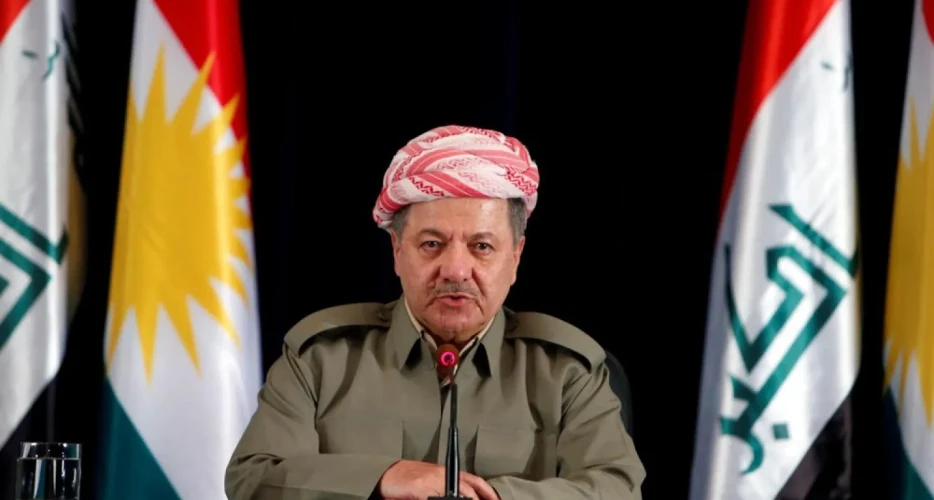
Peregraf — Masoud Barzani, the President of the Kurdistan Democratic Party (KDP), has rejected efforts to hold a parliamentary session to elect Iraq’s next president under current conditions. He warned Shiite and Sunni leaders that rushing the process could deepen political divisions and destabilize the country.
In a letter sent on March 28 to leaders of the Shiite Coordination Framework and the Sunni National Political Council in Baghdad, the KDP President cautioned that "haste or imposition will lead to opposite results and deeper division." He stressed that electing a president and moving forward with government formation requires broader consultation and consensus among political forces.
Barzani called for intensified bilateral and multilateral dialogue to overcome the current impasse, urging political actors to temporarily set aside contentious issues until "constitutional entitlements are completed based on the principles of partnership, balance, and national consensus." He emphasized that Kurdish parties have yet to agree on a unified candidate, reiterating that such a decision should first be finalized within Kurdish factions.
Despite his party emerging as the largest Kurdish bloc in recent elections, Barzani insisted on respecting the electoral weight and rights of all political components. He also framed his appeal as a matter of national responsibility amid rising regional tensions—specifically the ongoing US-Israel War on Iran, now in its 30th day. He called for patience, warning that political missteps could threaten Iraq’s internal stability and social peace.
His intervention comes as momentum builds within Iraq’s parliament to break the prolonged deadlock. More than 220 lawmakers have signed a petition to convene a session on March 30 to elect a president, signaling growing pressure to resolve one of the country’s most critical constitutional crises.
Mohammed al-Halbousi, the Speaker of the Council of Representatives, has strongly backed the move, warning that continued delays are "no longer acceptable" due to their direct impact on state stability and the functioning of government institutions. He stated that lawmakers have already been given sufficient time to reach consensus and that parliament must now fulfill its constitutional duty.
"We face a clear national responsibility to conclude this milestone and choose a figure who represents everyone," Halbousi said, adding that Iraqis are increasingly frustrated by the prolonged stalemate.
However, divisions remain sharp—particularly among Kurdish factions. According to Dilan Ghafour, a Member of the Iraqi Parliament, all Kurdish parties except the KDP have backed the petition to hold the session, highlighting ongoing disputes within the Kurdish political bloc.
Under Iraq’s parliamentary rules, only 50 signatures are required to place a vote on the agenda, but a two-thirds quorum of 220 lawmakers (out of 329) is needed to elect a president—a threshold that has repeatedly obstructed previous attempts.
The presidency, traditionally held by a Kurdish figure under Iraq’s post-2003 power-sharing system, has become a focal point of competition. Incumbent Abdul Latif Rashid is seeking a second term, while the Patriotic Union of Kurdistan (PUK) has nominated Nizar Amedi, and the KDP has put forward Fuad Hussein.
The broader political landscape remains further complicated by divisions within Shiite factions over the next prime minister, as well as external pressures and the activities of the Islamic Resistance in Iraq. The failure to elect a president has effectively frozen Iraq’s political process, as the president is required to formally designate a prime minister tasked with forming a new government.
With constitutional deadlines already missed and repeated sessions failing due to lack of quorum, the risk of continued paralysis remains high. Shiite blocs have warned they may boycott future sessions if Kurdish factions do the same, raising fears of a prolonged institutional crisis.
As political pressure mounts, Barzani’s call for delay underscores a fundamental divide: whether to prioritize swift constitutional action or pursue a slower, consensus-driven approach to avoid further fragmentation during the US-Israel War on Iran.