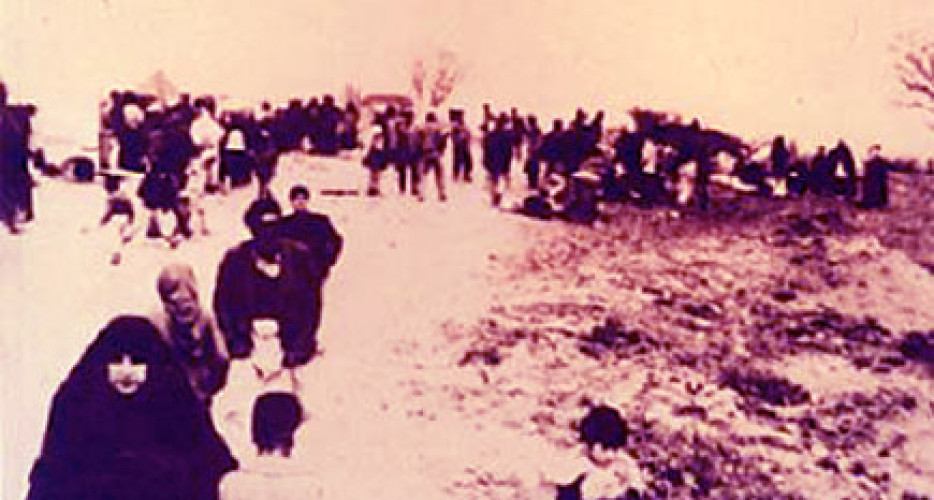
Peregraf — Forty-six years after the Iraqi government began a campaign of deportation, statelessness and mass disappearance against the Faili Kurds, political leaders in the Kurdistan Region marked the anniversary on Saturday with renewed calls for justice, reparations and historical accountability.
The commemorations recalled one of the lesser-known atrocities carried out under Iraq’s former Ba’athist regime, when tens of thousands of Faili Kurds were stripped of their citizenship, forcibly expelled to Iran and, in many cases, disappeared. Thousands of young men were detained and never seen again.
In a statement, Masoud Barzani, president of the Kurdistan Democratic Party, described April 4 as “a somber day in the calendar of the people of Kurdistan,” honoring what he called the “genocide of our Faili brothers and sisters.”
“They faced oppression, mass murder and injustice simply for being Kurdish,” he said, adding that the revocation of citizenship and forced deportations were part of a “systematic and ongoing inhumane policy” carried out by the former Iraqi regime.
Faili Kurds, an ethnic Kurdish group that predominantly follows Shia Islam, have long occupied a vulnerable position in Iraq’s social and political landscape. Their dual identity — both Kurdish and Shia — subjected them to discrimination across successive governments, but it was under Saddam Hussein’s rule that persecution reached its peak.
Beginning in the late 1970s and intensifying in the early 1980s, Iraqi authorities accused many Faili Kurds of having Iranian origins, a pretext used to expel entire families. Property was confiscated, identification documents were revoked and families were separated at the border. Human rights groups estimate that tens of thousands were deported, while thousands of young men disappeared into prisons and secret detention centers.
In 2010, Iraq’s Supreme Criminal Tribunal formally recognized the campaign against the Faili Kurds as genocide, placing it alongside other atrocities committed by the Ba’athist regime, including the Anfal campaign and chemical attacks against Kurdish civilians.
Despite that legal recognition, many Faili Kurds say justice remains incomplete.
Masrour Barzani, prime minister of the Kurdistan Regional Government, said the anniversary was a reminder of Baghdad’s “moral, legal and constitutional responsibility” to compensate victims.
“Thousands of Feyli Kurds were killed, disappeared and displaced,” he said. “We remind the federal government of its obligation to provide reparations to the victims.”
The call reflects a broader Kurdish demand that Baghdad address not only the Faili case, but also other crimes committed under the previous regime, including chemical weapons attacks and mass killings during the Anfal campaign.
Qubad Talabani, the Kurdistan Region’s deputy prime minister, framed the anniversary as both a moment of mourning and resilience.
“The Kurdish nation is greater and more ancient than any attempt by its enemies to destroy it,” he said. “Those crimes did not break our will — they strengthened our solidarity and shared destiny.”
Today, the Faili Kurds number more than 800,000 in Iraq, with significant populations in Baghdad, Diyala and Wasit provinces, as well as smaller communities in Kirkuk. While many returned after the fall of Saddam Hussein in 2003, others have faced renewed displacement due to insecurity and political instability.
Community leaders say that beyond financial compensation, key demands include the restoration of full citizenship rights, the return of confiscated properties and official recognition of the fate of the missing.
For many families, the anniversary remains deeply personal.
Decades later, questions linger about the thousands who vanished during the deportations — sons, brothers and fathers whose whereabouts have never been clarified. Their absence continues to shape the collective memory of the Faili Kurds, even as a younger generation seeks political inclusion and recognition.
Barzani, in his message, emphasized that the contributions of Faili Kurds to the Kurdish national movement should not be overlooked.
“Faili Kurds will always remain a cherished part of the nation of Kurdistan,” he said.
Yet for many, remembrance alone is not enough.
As Iraq continues to navigate its post-conflict identity, the legacy of the Faili Kurdish genocide stands as a test of the country’s willingness to confront its past — and to deliver justice to those who have waited nearly half a century.