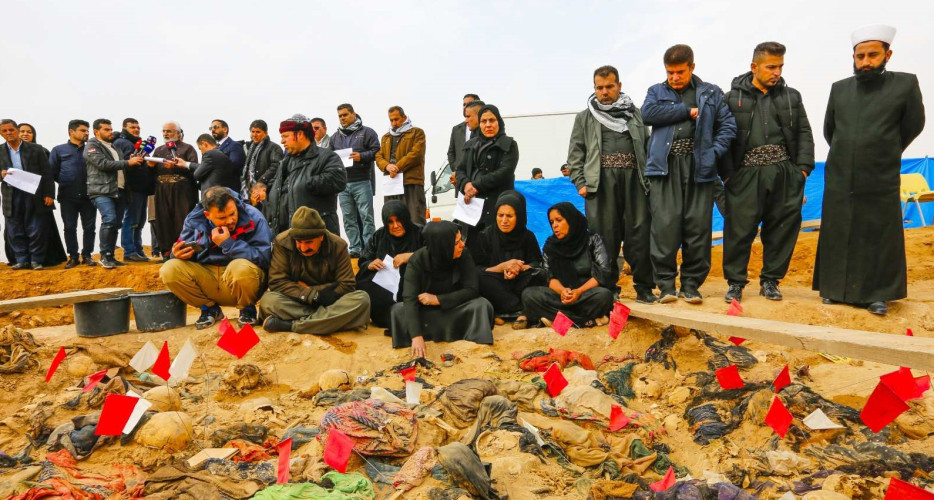
Peregraf — Thirty-eight years after the Anfal Campaign, Kurds continue to commemorate one of the darkest chapters in their modern history, while survivors push for accountability for those responsible.
The Anfal campaign was carried out in 1988 by Iraq’s former Ba’ath regime and lasted for seven months. Between February and September of that year, an estimated 182,000 Kurds were killed, thousands of villages were destroyed, and entire communities were forcibly displaced across multiple provinces.
The campaign involved mass executions, disappearances, and systematic destruction. Many victims were buried in mass graves, while others were taken to detention sites in southern Iraq.
One of the most brutal phases of the campaign took place in the Garmiyan region, where entire villages were wiped out. Large numbers of civilians were forcibly transferred to camps in southern provinces.
Among the most notorious sites was Nugra Salman Prison, a remote desert detention center that became a symbol of suffering during Anfal. Survivors have described widespread abuse, starvation, and mass killings at the facility.
Decades later, efforts to bring perpetrators to justice continue.
On July 31, 2025, the arrest of Ajaj Ahmad Hardan al-Tikriti, known among survivors as Hajjaj Nugra Salman, was announced by Iraq’s former First Lady Shanaz Ibrahim Ahmad. Her office said it had tracked him for eight months.
Ajaj is accused of serving as a prison officer at Nugra Salman during the Anfal campaign, where he allegedly oversaw torture, executions, and other abuses. After the fall of Saddam Hussein’s regime in 2003, he disappeared and remained a fugitive for more than two decades.
For many survivors, the arrest represents a rare step toward justice. They hope that testimonies and admissions linked to the case will strengthen calls for accountability for crimes committed during the Anfal campaign.