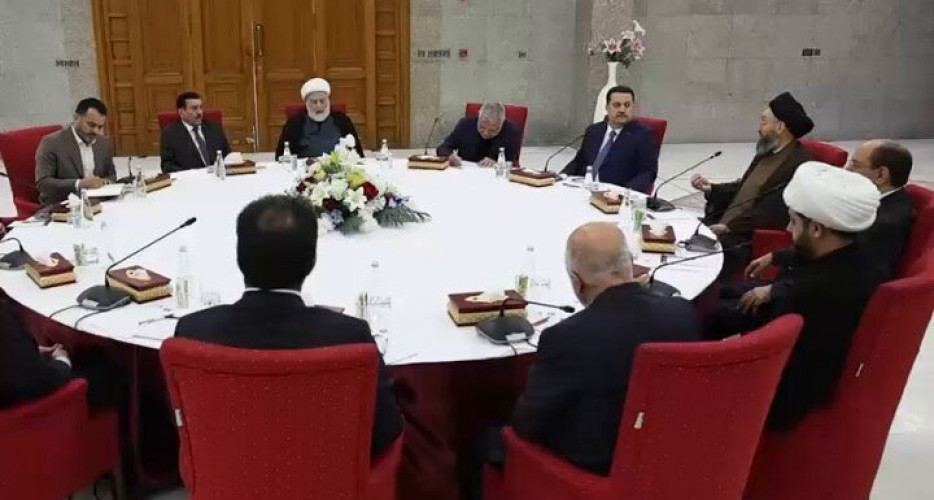
Peregraf — A planned meeting of Iraq's ruling Coordination Framework (CF) to finalize its prime minister candidate has been postponed to Wednesday, sources told Peregraf, even as the alliance reportedly reached a majority decision on its nominee.
An informed source in Baghdad told Peregraf that the CF had settled on Basim al-Badri as its prime minister candidate through a majority vote, but was unable to officially announce the nomination due to the emergence of internal objections and protests.
The delay comes despite reports from several Iraqi media outlets that the CF had agreed to put forward al-Badri, a senior figure within the Islamic Dawa Party. Sources said disagreements resurfaced following the vote, preventing any immediate public announcement.
Abbas al-Amiri, Secretary-General of the CF, told reporters following Monday's session: "It was a very positive and responsible meeting, where all viewpoints and discussions were presented. Because more time was needed, the Coordination Framework decided to reconvene on Wednesday to conclude this dialogue. God willing, we will also continue the discussions tomorrow. The atmosphere is very positive, and we hope to reach a resolution by Wednesday."
The development comes with the constitutional deadline fast approaching. Iraq's parliament elected Nizar Amedi of the Patriotic Union of Kurdistan (PUK) as president on April 11, 2026, after which the constitution gives him 15 days to task the nominee of the largest parliamentary bloc with forming a government.
Who is Basim al-Badri?
Al-Badri has served since 2013 as head of the Supreme National Commission for Accountability and Justice, the body responsible for implementing Iraq's de-Baathification law and vetting candidates for senior government positions. He is a member of the Islamic Dawa Party, led by former Prime Minister Nouri al-Maliki, head of the State of Law Coalition.
Al-Badri is considered one of the senior political figures in Dawa Party circles and has previously been mentioned as a possible compromise candidate for the premiership.
The commission he leads traces its origins to a body established in November 2003 by L. Paul Bremer, Administrator of the Coalition Provisional Authority (CPA), following the U.S.-led invasion of Iraq. Originally known as the Supreme National De-Baathification Commission, the body was tasked with removing members of Saddam Hussein's Ba'ath Party from government positions. Its successor institution has since barred numerous political, military, and security figures over alleged ties to the former Ba'ath regime.
Political Context
The delay follows weeks of internal divisions within the CF over the candidacy of former Prime Minister Nouri al-Maliki. Al-Badri's possible nomination is seen by some political observers as an attempt to resolve the deadlock around al-Maliki's bid, which has drawn opposition both from within the CF and from Washington.
U.S. President Donald Trump said on his Truth Social platform that Iraq would be making "a very bad choice by reinstalling Nouri al-Maliki as Prime Minister," adding that the U.S. would "no longer help Iraq" if al-Maliki returned to office.
Within Iraq, figures including Ammar al-Hakim, head of the National Wisdom Movement (Al-Hikma), and Qais al-Khazali, Secretary-General of Asa'ib Ahl al-Haq, are also reported to have expressed reservations about al-Maliki's nomination.
Al-Badri's name has circulated among several candidates under consideration as political forces search for a compromise figure capable of securing broader support and ending the current impasse.