Peregraf — Iraq's ruling Shia political alliance is facing one of its deepest internal crises as today marks the final constitutional deadline to nominate a prime minister candidate to form the country's new government.
Under Article 76, Clause 1 of the Iraqi Constitution, the president must task the nominee of the largest parliamentary bloc with forming the cabinet within 15 days of the president's election. Since Nizar Amedi was elected on April 11, the deadline expires tonight.
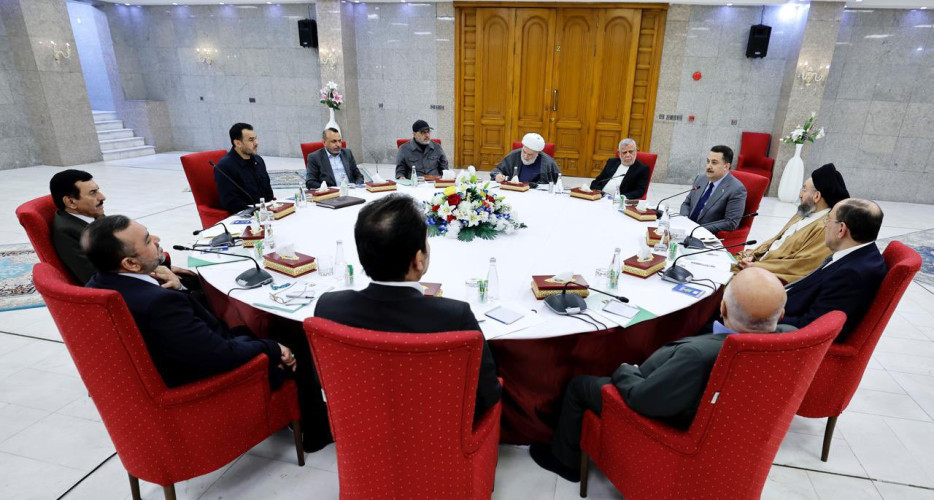
So far, the Coordination Framework (CF) has failed to agree on a candidate, with deepening divisions raising the possibility of a major split within what is often referred to as Iraq's "Shia House."
Bassem al-Badri and the Failed Consensus
Since last Monday, tensions have intensified after a CF meeting failed to finalize a nominee.
During that meeting, several Shia leaders reportedly agreed on nominating Bassem al-Badri — chairman of Iraq's Supreme National Commission for Accountability and Justice and a member of former Prime Minister Nouri al-Maliki's Islamic Dawa Party — who is widely described as the preferred candidate of al-Maliki and his State of Law Coalition.
However, a major faction of the alliance rejected his nomination, preventing an official announcement despite claims that he had secured majority support.
A follow-up meeting scheduled for Wednesday was canceled due to the depth of the disagreements, while another meeting on Friday ended without results. A decisive meeting planned for Saturday night was postponed again until today.
Even a recent visit to Baghdad by Esmail Qaani — commander of Iran's Islamic Revolutionary Guard Corps (IRGC) Quds Force, the body's elite external operations arm — reportedly failed to bridge the divide among Shia leaders.
Option One: Two-Thirds of Leaders
The first option under discussion is to finalize the prime minister candidate through a two-thirds majority among the 12 main leaders of the CF — requiring at least eight votes.
This option is supported by much of the leadership but opposed by major election winners, who argue it ignores parliamentary weight.
Caretaker Prime Minister Mohammed Shia' al-Sudani — whose Coalition for Construction and Development (also known as the Reconstruction and Development Coalition) won 46 seats, the largest result among CF factions — opposes this method. Al-Sudani has served as Iraq's prime minister since October 2022 and remains caretaker in the absence of a new government.
Al-Sudani had reportedly accepted al-Maliki's candidacy under pressure from senior Shia leaders, but after al-Maliki's prospects faded, he is said to have backed Ihsan al-Awadi, his current chief of staff, as an alternative.
Qais al-Khazali — secretary-general of Asa'ib Ahl al-Haq (AAH) and head of its political wing, the Sadiqoun bloc, which won 27 seats — and Ammar al-Hakim, head of the Al-Hikma National Movement, are also reported to oppose this first option.
Option Two: Vote of Framework MPs
The second option, strongly backed by al-Sudani's camp, is to let all 164 MPs affiliated with the CF vote and decide the nominee through a two-thirds parliamentary majority.
Al-Sudani's allies describe this as the fairest mechanism, arguing that although they hold fewer leadership positions, they command the majority of parliamentary seats.
The opposing side rejects this approach, saying it would weaken the authority of the CF's leadership and undermine its traditional role as the main Shia decision-making body.
Alternative and Other Scenarios
A hybrid option is also being discussed: requiring a candidate to secure eight of 12 leadership votes, provided those leaders represent at least 110 of the CF's 164 seats.
However, this formula is also difficult to implement and may simply create another deadlock.
Another fallback scenario involves choosing a compromise prime minister from outside the main winning blocs — a model Iraq has used repeatedly during political crises, including with al-Sudani himself when he was selected in 2022.
Risk of Full Political Deadlock
If the CF fails completely to reach an agreement, political leaders may split into two rival fronts, each attempting to form the largest parliamentary bloc by separately aligning with Sunni and Kurdish parties.
This would mirror the recent Kurdish dispute over the Iraqi presidency.
If no candidate is finalized by tonight, the constitutional deadline will expire without a clear legal solution. In that case, the president would likely seek guidance from Iraq's Federal Supreme Court.
The most likely outcome would be reopening the process of registering the "largest parliamentary bloc" as a constitutional path to resolving the crisis.