A Vague Accusation, a Collective Blame: Trump’s Iran Weapons Claims Leave Kurds Angry and Anxious
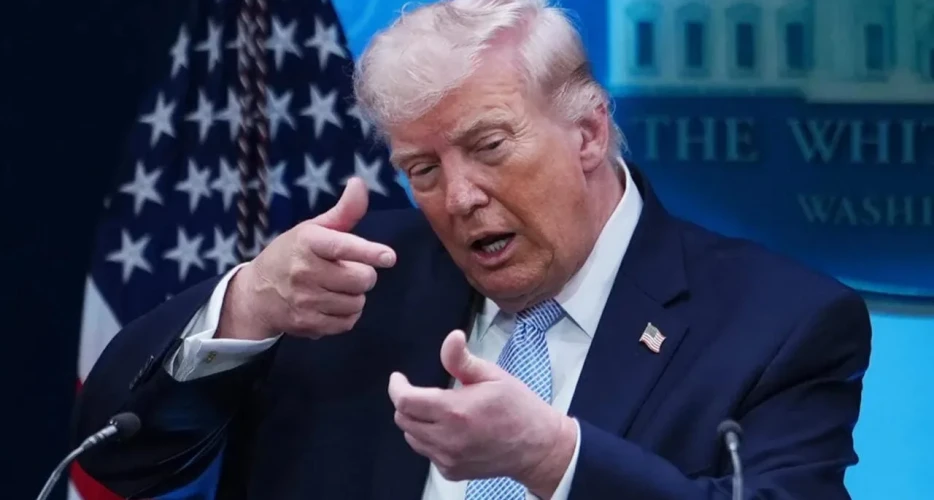
Peregraf - The latest controversy surrounding U.S. President Donald Trump has triggered a wave of anger, confusion, and unease across the Kurdistan Region of Iraq, after Trump repeatedly accused "the Kurds" of keeping American weapons that he said were intended for anti-government protesters in Iran.
The accusations, delivered without specifying any Kurdish group or organization, have ignited fears among many Kurds that an entire people are being collectively blamed for an alleged covert operation whose details remain unclear and unverified.
For many in Iraq’s Kurdistan Region, the controversy is not merely political. It touches a deeper historical nerve: the persistent reduction of the Kurds — a nation divided across Iraq, Iran, Turkey, and Syria — into a single indistinct entity in international discourse.
Trump’s remarks have also exposed longstanding frustrations among Kurds over how global powers, including American political leaders and media outlets, often misunderstand Kurdish geography, political divisions, and alliances.
The controversy first emerged publicly in early April 2026, during the U.S.-Israel war on Iran, which began on February 28, 2026, before a ceasefire was announced on April 8.
At the time, Trump said he was "very upset" with a group he accused of diverting weapons allegedly intended for anti-government protesters inside Iran.
"We sent guns, a lot of guns, and they were supposed to go to the people so they could fight back," Trump said in remarks relayed during a media interview. According to Trump, the intermediaries tasked with delivering the weapons instead kept them.
"They said, ‘what a beautiful gun, I think I’ll keep it,’" he added.
Trump warned that those responsible would face consequences.
"I’m very upset with a certain group of people and they’re going to pay a big price for that," he said.
He also argued that Iranian protesters would rise up if they had weapons and were no longer vulnerable to being immediately shot by Iranian security forces.
"Go out in the streets, they will be immediately shot. They don’t have guns," Trump said.
The allegations quickly spread after comments attributed to Trump in an interview with Trey Yingst, in which Trump reportedly claimed that the United States had sent "a lot of guns" to Iranian protesters and that "the Kurds kept them."
The following weeks saw growing confusion and anger across Kurdish communities, especially because Trump never specified which Kurdish faction or organization he was accusing.
"We thought the Kurds were going to give us weapons, but the Kurds disappointed us," Trump said again on May 11 during remarks that quickly circulated across Kurdish media and social platforms.
"The Kurds take, take, take," he added, criticizing what he described as Kurdish dependence on American support.
Trump claimed that weapons and ammunition had been sent through Kurdish channels for Iranian protesters but were never delivered. "They kept it," he said. "I said, ‘They’re going to keep it.’"
The following day, on May 12, a reporter from Rudaw Media Network directly challenged Trump during a press interaction, noting that U.S. military officials and Kurdish political groups had all denied receiving any such weapons.
"The officials are wrong," Trump replied.
The statements intensified outrage across Kurdish political and intellectual circles, where many viewed the accusations as dangerously vague.
Kurds are spread across four countries and encompass dozens of political movements, armed groups, and rival parties. In Iraq alone, the autonomous Kurdistan Region maintains its own parliament, government, and Peshmerga forces. The region’s two dominant political factions — the Kurdistan Democratic Party and the Patriotic Union of Kurdistan — both maintain longstanding relations with Washington.
Yet both parties, along with the Kurdistan Regional Government’s Ministry of Interior, have categorically denied receiving any weapons connected to Trump’s allegations.
Iranian Kurdish opposition parties based in Iraq’s Kurdistan Region have issued similar denials.
A senior source from the Alliance of Political Forces of Iranian Kurdistan told Peregraf that reports suggesting Kurdish opposition factions had received American weapons were "inaccurate and do not reflect reality."
The alliance, formed in February 2026, includes several major Iranian Kurdish opposition organizations, among them the Kurdistan Freedom Party, Free Life Party of Kurdistan, Democratic Party of Iranian Kurdistan, Komala Party of Iranian Kurdistan and other groups operating from bases inside Iraq’s Kurdistan Region.
Iranian Kurdish opposition groups have also repeatedly denied involvement in direct military operations tied to the conflict with Tehran. Earlier statements from the groups rejected reports claiming their fighters had crossed into Iran to participate in armed confrontations against the Islamic Republic.
But Kurdish critics say the issue is no longer only about weapons. Instead, they argue, Trump’s rhetoric has transformed the Kurds themselves into political scapegoats.
"This unjust position by the U.S. President casts doubt on all Kurds and damages the relations between the Kurds and America," the Executive Council of the Kurdistan National Congress said in a statement.
The organization urged Trump to clarify exactly which Kurdish group he was referring to and warned against criminalizing an entire people.
"Mr. Trump must not criminalize all Kurds," the statement said.
The remarks have also fueled fierce debate among Kurdish intellectuals, many of whom argue that the Kurdish reaction itself reflects deeper political fragmentation.
Dr. Yousif Mohammed, former speaker of the Kurdistan Parliament, described the controversy as "a major scandal for the Kurds."
"The issue of ‘Trump’s weapons’ has become a major scandal for the Kurds, even distorting our history and sacrifices," he wrote. "The regional authorities must provide a clear explanation."
Among the sharpest critiques came from the Kurdish writer and researcher Dr. Sardar Aziz, who argued that the Kurdish response revealed what he called "a deep intellectual crisis."
"Trump says ‘the Kurds.’ The Kurds ask: ‘Which Kurds?’" Aziz wrote.
He argued that many Kurds mistakenly believed Trump was addressing Kurdish audiences directly, when in fact his intended audience was American domestic politics.
Aziz described Trump as possessing a "bully" mentality and characterized him as a political narcissist who refuses to accept failure and constantly seeks scapegoats.
"A narcissist is always looking for a party or person to blame who lacks the power to defend themselves," he wrote.
But Aziz reserved some of his strongest criticism for Kurdish political factions themselves, accusing the KDP and PUK of exploiting the controversy for partisan rivalries instead of defending Kurdish interests collectively.
"The only ones who benefit from this are the enemies of the Kurds," he wrote.
For many Kurds, the episode has reopened uncomfortable questions about the fragile relationship between Kurdish movements and Washington.
For decades, Kurdish forces in Iraq and Syria have been among America’s closest regional partners, particularly in the fight against the Islamic State. Kurdish leaders have often portrayed that partnership as evidence of strategic trust between the United States and the Kurds.
Yet Trump’s remarks have revived older Kurdish fears that alliances with major powers remain conditional, temporary, and vulnerable to abrupt political shifts.
The ambiguity surrounding the allegations has only deepened those anxieties.
No evidence has been publicly presented showing that weapons were transferred to Kurdish groups for delivery into Iran. No Kurdish organization has acknowledged involvement. American officials cited by Kurdish media have also reportedly rejected Trump’s claims.
Still, Trump has continued to insist that the weapons existed and that Kurdish actors diverted them.
In the absence of proof or clarification, many Kurds now fear that the controversy may leave behind something more lasting than a political dispute: a stain attached to the Kurdish name itself.