Peshmerga Unification 'Not Progressing as Required,' Barzani Warns Delays Damage Kurdistan Region's Reputation
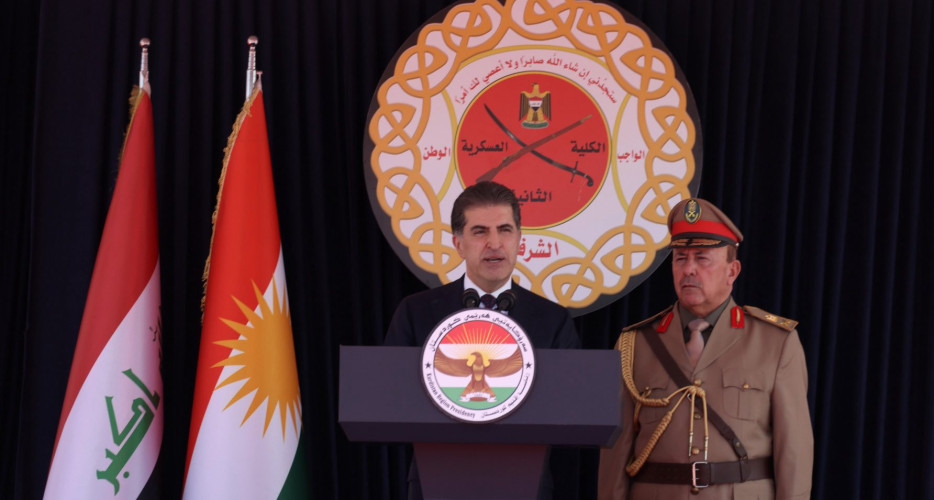
Peregraf- Kurdistan Region President Nechirvan Barzani said the process of unifying the Peshmerga forces is still not advancing as required, warning that the lack of progress has damaged the reputation of the Kurdistan Region despite years of international backing.
Speaking during a graduation ceremony at Zakho Military Academy, Barzani said the people of Kurdistan have waited years for the unification of the Peshmerga forces.
"The process of unifying the Peshmerga forces is not progressing as required, and the necessary progress has not yet been achieved," he said.
"Our friends in the International Coalition provide support, planning, and cooperation; they expect us to demonstrate a proper and strong political will. Unfortunately, this has not happened yet, and this has caused significant damage to the reputation of the Kurdistan Region."
Barzani on the International Coalition
Barzani expressed thanks to the International Coalition, led by the United States, for supporting both the Peshmerga and Iraqi forces during the war against ISIS. He described coalition assistance as "strategic and decisive" and cited what he called continued support for reform efforts within the Ministry of Peshmerga Affairs (MoPA).
Need for Coordination With Iraqi Army
The Kurdistan Region president also stressed the importance of cooperation between the Peshmerga and the Iraqi Army, particularly in the disputed territories designated under Article 140 of the Iraqi Constitution.
According to Barzani, ISIS remains a continuing threat to Iraq and the wider region.
He also acknowledged Peshmerga fighters, Iraqi soldiers, and members of the Popular Mobilization Forces (PMF) killed during the conflict against ISIS.
Persistent Obstacles to Reform
Despite years of reform discussions, the unification process continues to face major political and structural obstacles.
Most Peshmerga forces remain divided between:
Unit 80, affiliated with the Kurdistan Democratic Party (KDP)
Unit 70, affiliated with the Patriotic Union of Kurdistan (PUK)
A 2025 report from the Lead Inspector General for Operation Inherent Resolve (OIG) identified political rivalries, financial constraints, and slow integration as key barriers to reform.
US-Backed Reform Framework
The reform process is based on a 2022 Memorandum of Understanding (MoU) between the U.S. Department of Defense (DoD) and the Ministry of Peshmerga Affairs (MoPA) aimed at integrating partisan forces under the ministry's command structure.
In February 2026, KRG Prime Minister Masrour Barzani signed a directive expanding administrative and military authority within the ministry as part of efforts to accelerate reform and reduce partisan divisions.
Coalition financial and military support has increasingly been tied to the integration of forces into the ministry's official structure.