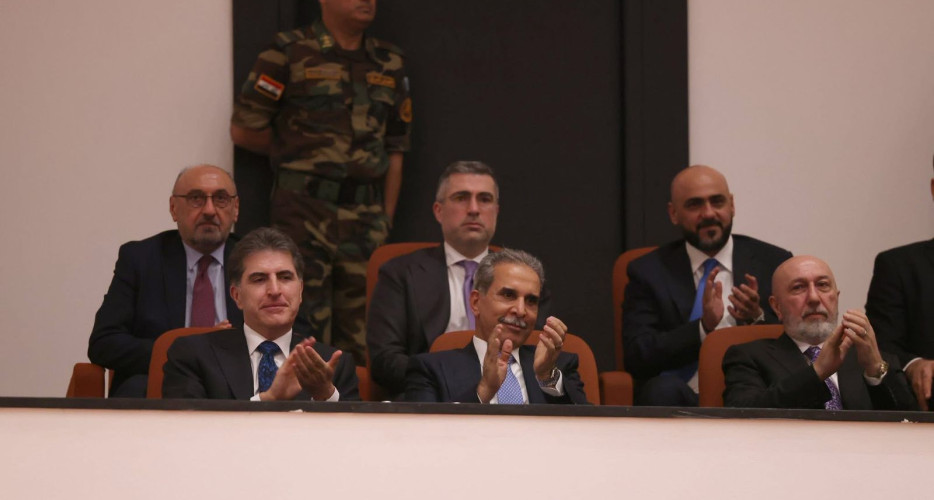
Peregraf - When Nechirvan Barzani, President of the Kurdistan Region and Vice President of the Kurdistan Democratic Party (KDP), entered Iraq's parliament on Thursday for the confidence vote on the country's new cabinet, the symbolism was difficult to miss. Seated only one chair away from Iraq's newly sworn-in president, Nizar Amedi, he neither greeted him nor acknowledged him publicly.
For years, Nechirvan Barzani has cultivated an image as the Kurdistan Region's most prominent statesman. Kurdish and regional media close to the KDP have frequently described him as an "ambassador of peace" and portrayed him as a rare Kurdish figure accepted across Baghdad, Ankara, Tehran, and Washington.
Yet the scene inside parliament underscored a recurring pattern in Kurdish politics: Nechirvan Barzani may project moderation, but he remains bound by the political red lines of his party.
Amedi, a former Iraqi Minister of Environment and a member of the Patriotic Union of Kurdistan (PUK), was elected President of Iraq on April 11 after Kurdish parties failed to agree on a unified candidate. Since then, the KDP has refused to recognize his legitimacy, boycotted the presidential vote, and declined to formally congratulate him.
The refusal has extended beyond party statements into public conduct.
In the 33 days since Amedi's election, Nechirvan Barzani has twice traveled to Baghdad, holding meetings with Shia and Sunni leaders across Iraq's political spectrum. But he has not visited the president's office. On Wednesday, despite sitting near Amedi during one of Iraq's most consequential parliamentary sessions of the year, he again avoided direct engagement.
The moment stood in contrast to another interaction inside the chamber. At one point, Bafel Talabani, President of the PUK, approached Nechirvan Barzani and quietly spoke with him, prompting the Kurdistan Region president to rise from his seat for a brief exchange.
The juxtaposition was striking: a conversation with a rival party leader appeared possible, while any recognition of Iraq's president remained politically off limits.
The dispute reflects the broader struggle between the KDP and the PUK, the two dominant Kurdish parties that have shaped politics in the Kurdistan Region for decades. Though the Iraqi presidency is largely ceremonial, the office carries symbolic and constitutional weight in Iraq's fragile power-sharing system.
Since 2003, the post has traditionally been held by a Kurdish politician through intra-Kurdish consensus. But that consensus has steadily eroded.
The KDP argues that Amedi's election bypassed the traditional Kurdish mechanism for selecting a joint candidate and insists the presidency should represent all of Kurdistan rather than the interests of a single party. The party has also claimed the parliamentary session that elected him violated procedural rules.
Critics say the standoff reveals something deeper: the inability of Kurdish leaders to separate state institutions from party rivalries.
For Nechirvan Barzani personally, the controversy cuts against the image his allies have sought to project. As president of the Kurdistan Region, his office is meant to represent all citizens of the region, not merely the position of the KDP. Yet his conduct toward Iraq's president has mirrored the exact posture adopted by his party leadership.
The result is a growing perception that even Kurdistan's most internationally connected politician cannot step outside the boundaries imposed by partisan politics.
In Iraqi Kurdistan, where institutions have long struggled to function independently of party control, that perception carries consequences beyond symbolism. It reinforces a broader public skepticism that political offices remain subordinate to party interests, even at the highest levels of government.
And in a political system already strained by distrust between Erbil and Baghdad — and between the Kurdish parties themselves — even a missed handshake can become a measure of a deeper divide.