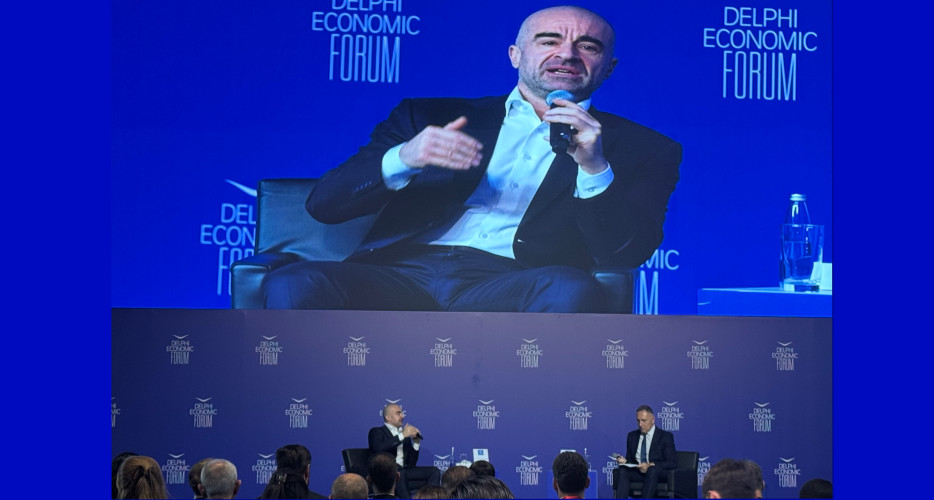
Peregraf- The president of one of Iraqi Kurdistan's two dominant political parties said on Saturday that he would oppose the formation of a new regional government if it resembled the administration that preceded it, underscoring deep political divisions that have left the Kurdistan Region without a functioning government for more than 18 months.
Speaking at the Delphi Economic Forum in Sulaymaniyah, Bafel Talabani, president of the Patriotic Union of Kurdistan (PUK), criticized the political model that has governed the autonomous region in recent years and called for a broader coalition among Kurdish parties.
"I think that there will be no government in Kurdistan if the government in Kurdistan is going to be like the last one," Talabani said during a panel discussion at the forum. He urged participants to speak with ordinary citizens, arguing that public dissatisfaction with the previous administration was widespread.
"Nobody wants that, whatever that was, passable for a government," he said. "That has to be changed."
His remarks come as negotiations over the formation of the Kurdistan Regional Government's (KRG) 10th cabinet remain stalled following parliamentary elections held on Oct. 20, 2024.
Although the newly elected parliament held its inaugural session on Dec. 2, 2024, lawmakers have not reconvened since, leaving the legislature effectively inactive. Disputes between the PUK and its longtime rival, the Kurdistan Democratic Party (KDP), over power-sharing arrangements, leadership positions, and cabinet formation have prevented the establishment of a new government.
Talabani said the region's political deadlock reflected a deeper failure among some political leaders to understand the principles of coalition governance.
"The fundamental understanding of what a coalition government is, I don't think it exists in certain people's heads," he said. Continuing to pursue policies built on "incorrect foundations," he added, would make success impossible.
He pointed to growing political tensions and institutional strains in the Kurdistan Region, saying residents were already witnessing "cracks in the system" and disputes over constitutional issues.
The PUK president called for a governing framework that would include all major Kurdish parties, drawing comparisons to Iraq's federal political system, where rival factions participate in a broad governing coalition.
"We should all be together," Talabani said. "All of the Kurdish parties should have a council."
The Delphi Economic Forum, being held for the second consecutive year in Sulaymaniyah, has brought together regional and international officials to discuss economic development, security challenges, and geopolitical trends.
Among the participants are Nizar Amedi, President of Iraq, Ahmet Davutoğlu, former Prime Minister of Türkiye and current leader of the Future Party, and Giorgos Gerapetritis, Greece's Minister of Foreign Affairs, as well as deputy prime ministers from Bulgaria and Romania.
Organizers say discussions are expected to focus on energy security, regional stability, investment opportunities, and governance reforms.
The prolonged political paralysis in the Kurdistan Region has delayed approval of a new cabinet and budget while fueling criticism of regional institutions. Talabani argued that any future government would require a renewed commitment to political partnership, stronger relations with Baghdad, and a more realistic assessment of the Middle East's evolving security landscape.
Without such changes, he suggested, efforts to form a stable administration are unlikely to succeed.