Trump Doubles Down on Claims That Kurds Kept U.S. Weapons Intended for Iranian Protesters
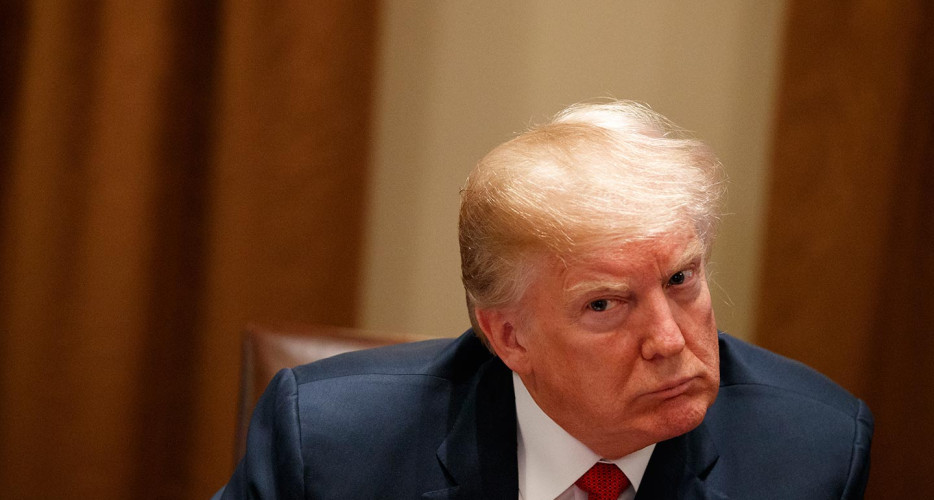
Peregraf — U.S. President Donald Trump on Thursday renewed allegations that Kurdish groups had diverted American weapons intended for anti-government protesters in Iran, repeating claims that have triggered anger, confusion, and concern across Kurdish communities in the Middle East.
Speaking on Fox & Friends on June 11, Trump said the United States had sent weapons that were supposed to reach opponents of the Iranian government but were instead kept by Kurdish intermediaries. He also acknowledged that he had opposed the plan from the start, saying he had initially believed the Kurds would keep the weapons rather than pass them on.
"We actually sent them weapons and we were very disappointed by the Kurds, to be honest with you. The Kurds let us down," Trump said. "I think they kept them for themselves. I think it's a disgrace. But I'll remember that, Kurds, I'll remember that."
Trump did not specify which Kurdish organization, political party, or armed group he was referring to, nor did he provide evidence to support his allegations.
The remarks were the latest in a series of statements that began during the U.S.-Israel War on Iran and have since evolved into a controversy that has unsettled many Kurds, particularly in Iraq's Kurdistan Region.
The issue first emerged publicly on April 5, when Trump told Fox News chief foreign correspondent Trey Yingst in a phone interview that the United States had sent weapons to Iranians who, in his view, could have challenged their government if adequately armed. The interview aired on Fox & Friends on April 5–6.
"We sent guns, a lot of guns, and they were supposed to go to the people so they could fight back," Trump said at the time.
According to Trump, the intended recipients never received the weapons because those entrusted with delivering them allegedly kept them.
In subsequent comments, Trump repeatedly identified "the Kurds" as responsible, without clarifying whether he was referring to Kurdish groups in Iraq, Syria, Iran, or elsewhere.
The broad nature of the accusation has become a central source of frustration among Kurds, who note that more than 30 million Kurds live across Iraq, Iran, Türkiye, and Syria and are represented by dozens of political parties, armed movements, and rival organizations.
Many Kurdish politicians and intellectuals argue that Trump's statements treat a diverse population as a single political entity, ignoring deep divisions among Kurdish groups and the complex political realities of the region.
The controversy intensified on May 13 when a journalist confronted Trump with the U.S. military's denial of his claims. U.S. military officials had stated that reports claiming Kurds received weapons from the U.S. were false.
"The officials are wrong," Trump replied.
Since then, Kurdish authorities and opposition groups have continued to reject the allegations.
The Kurdistan Regional Government's (KRG) Ministry of Interior has denied that any weapons connected to Trump's claims entered the Kurdistan Region. The region's two dominant political parties, the Kurdistan Democratic Party (KDP) and the Patriotic Union of Kurdistan (PUK), have also rejected the accusations. A senior KRG official told the Ministry of Peshmerga that officials were "not aware of any weapons being transferred" to the Kurds.
Iranian Kurdish opposition organizations based in Iraq's Kurdistan Region have issued similar denials.
A senior source within the Coalition of Political Forces of Iranian Kurdistan (CPFIK) — an alliance of major Iranian Kurdish opposition groups formed on February 22, 2026 — told Peregraf that reports suggesting Kurdish factions received American weapons were inaccurate and did not reflect reality.
The coalition includes the Kurdistan Freedom Party (PAK), the Free Life Party of Kurdistan (PJAK), the Democratic Party of Iranian Kurdistan (PDKI), and the Khabat Organization of Iranian Kurdistan, along with Komala of the Toilers of Kurdistan. The Komala Party of Iranian Kurdistan later joined the coalition as well.
The groups have also denied reports suggesting their fighters crossed into Iran to participate in military operations during the conflict.
As the controversy has grown, criticism has expanded beyond the allegations themselves.
The Executive Council of the Kurdistan National Congress (KNK) accused Trump of unfairly casting suspicion on an entire people and warned that such statements could damage relations between Kurds and the United States.
"Mr. Trump must not criminalize all Kurds," the organization said in a statement, calling on the U.S. president to clarify exactly which group he was accusing.
The debate has also exposed divisions within Kurdish political circles.
Yousif Muhammed Sadiq, a Gorran Movement politician who served as Speaker of the Kurdistan Region Parliament from 2014 to 2019, described the episode as deeply damaging, arguing that it risked undermining decades of Kurdish political struggle and sacrifice.
Among the most widely discussed reactions was that of Sardar Aziz, a senior advisor in the Kurdistan Parliament and political researcher, who argued that Trump's remarks revealed both a misunderstanding of Kurdish realities and a broader weakness in the Kurdish response.
"Trump says 'the Kurds.' The Kurds ask: 'Which Kurds?'" Aziz wrote.
He argued that Trump was speaking primarily to an American political audience rather than to Kurds themselves, and described the U.S. president's rhetoric as an attempt to shift blame for an alleged failure onto a politically vulnerable target. At the same time, Aziz criticized Kurdish political parties for using the controversy to score points against one another rather than presenting a unified response.
For many Kurds, the episode has revived longstanding concerns about the reliability of international alliances. Kurdish forces in Iraq and Syria have been among Washington's closest regional partners over the past decade, particularly in the campaign against the Islamic State (ISIS). Yet Trump's comments have rekindled fears that support from major powers can be conditional and subject to sudden political shifts.
No evidence has been publicly presented to support Trump's allegations. No Kurdish organization has acknowledged receiving weapons intended for Iranian protesters, and Kurdish officials say they have received no information from Washington substantiating the claims. A source familiar with the matter told a U.S. outlet in May that the weapons were never transferred beyond American custody and remain stored at U.S. military bases in the region.
Nevertheless, Trump has continued to insist that the weapons existed and that Kurdish actors diverted them.
In the absence of evidence or further clarification, the controversy has evolved from a dispute over an alleged covert operation into a broader debate about Kurdish identity, international perceptions, and the future of Kurdish-American relations.