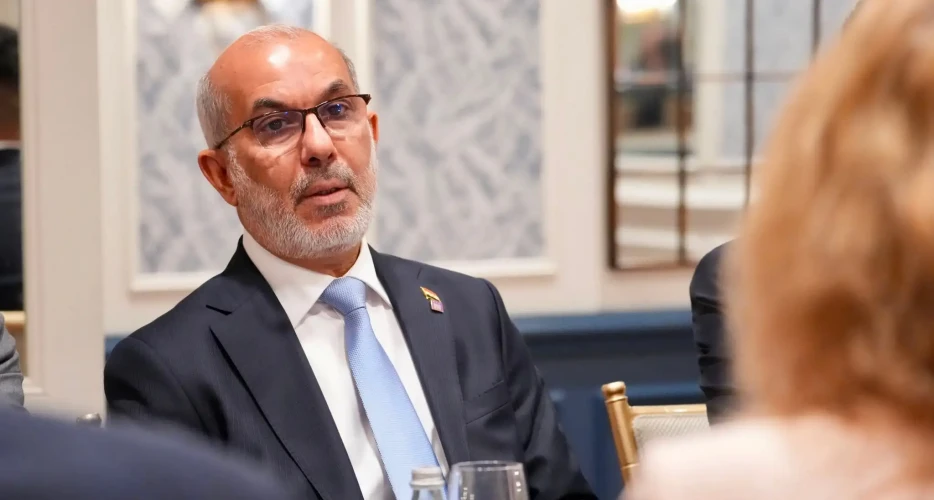
Peregraf — Iraqi Oil Minister Bassim Mohammed Khudair, also known as Bassim al-Abadi, said Baghdad is advancing plans for a crude pipeline system linking Basra with Faysh Khabur and Turkey’s Mediterranean port of Ceyhan, alongside a branch from Haditha to Syria’s Baniyas. He did not provide a detailed map of the proposed northern route.
Khudair’s reference to Faysh Khabur identifies a northern endpoint or connection area, not a fully disclosed corridor. His remarks do not establish whether the pipeline would pass through territory administered by the Kurdistan Regional Government, remain within a federally controlled route, or use both. The available cabinet description likewise provides no detailed alignment or map.
Speaking during the Iraqi delegation’s Washington visit, Khudair said a consortium involving U.S. companies Capital TI and Chevron, Qatar’s UCC Holding and an Iraqi oil company would undertake the project. Iraq’s cabinet has authorized preliminary, non-binding agreements and feasibility studies, while AP reported that unnamed Iraqi officials expected a Friday signing and capacity of about two million barrels daily.
Khudair’s comments followed talks between U.S. President Donald Trump, a Republican, and Iraqi Prime Minister Ali al-Zaidi, an independent backed by the Coordination Framework. The minister described the discussions as frank and said both sides supported attracting international companies. Trump said U.S. firms would conduct substantial oil business in Iraq, without disclosing contractual details.
The minister said Iraq wants to attract major U.S. companies into upstream and downstream operations, naming Chevron and ExxonMobil. He presented the policy as part of a broader effort to rebuild infrastructure and increase state revenue after decades of conflict and economic instability, while describing Iraq’s investment environment as increasingly stable and commercially attractive.
Khudair said Chevron was involved in discussions covering four areas: West Qurna 2, four blocks connected to Nasiriyah, the Balad field and strategic pipeline infrastructure. Chevron’s exclusive negotiations over West Qurna 2 have been publicly confirmed, but the minister did not provide final contracts, investment amounts or implementation schedules for the other proposed projects.
The pipeline proposal follows severe disruption to tanker traffic through the Strait of Hormuz during the U.S.-Israel war on Iran. Khudair said Iraq had pursued multiple export routes even before the war, arguing that a country with large oil reserves should not depend on one outlet. He announced no construction timetable, project cost or guaranteed capacity.
The public descriptions of the northern route are not identical. Khudair referred to a line from Basra to Faysh Khabur and onward to Ceyhan, while the cabinet-approved feasibility studies compare a Basra-Haditha-Kirkuk-Ceyhan route with a Basra-Haditha-Baniyas route. Until technical plans are released, the precise path and administrative jurisdictions remain unclear.
Khudair also listed the Akkas and Mansuriya gas fields, TotalEnergies’ Ratawi project and gas blocks awarded through Iraq’s fifth-plus and sixth licensing rounds. He said Baghdad wants to capture more gas for electricity generation, expand production capacity and create what he described as a larger field of work for U.S. energy and power companies.
The minister said Iraq was negotiating within the Organization of the Petroleum Exporting Countries and its allies, known as OPEC+, for greater room to produce and export oil. Prime Minister Ali al-Zaidi has separately said Iraq will remain in OPEC but wants what he describes as a fairer production quota reflecting the country’s circumstances.
At the close, Khudair thanked the U.S. government and said the partnership would benefit both countries. The recording contained no responses from Chevron, Capital TI, UCC Holding or ExxonMobil. Their involvement, the pipeline’s eventual route and the scope of proposed projects therefore remain government statements or preliminary plans unless confirmed through signed agreements and technical documents.