Iraq Signs 48 Agreements With US Companies Across Energy, Industrial, and Technology Sectors
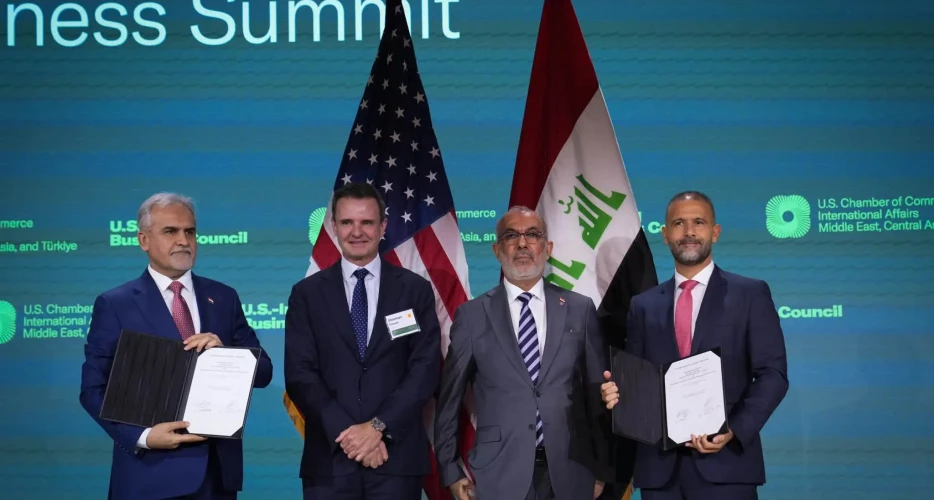
Peregraf — Iraqi Prime Minister Ali al-Zaidi oversaw the signing of 48 agreements, memorandums of understanding, and partnership declarations between Iraqi and US public and private sector entities on July 17, according to Iraq's Prime Minister's Office. The signings took place at the U.S.-Iraq Business Summit, hosted by the U.S. Chamber of Commerce in Washington, D.C., during al-Zaidi's first official visit to the US capital, which began on July 13.
The agreements included cooperation deals between Iraq's oil and electricity ministries and their affiliated companies with several major US firms, among them ExxonMobil, KBR, GE Vernova, Shell, and Halliburton. A separate agreement was signed between Starlink, owned by Elon Musk's SpaceX, and Iraq's Communications and Media Commission (CMC) to formally introduce the service in the country, along with an additional cooperation agreement with Halliburton.
Additional memorandums covered a partnership between Keysight Technologies and Iraq's private sector, along with an agreement with PepsiCo. Further agreements were signed with KBR, UOP, Polaris, the Association of Energy Engineers (AEE), and PPTA, described as a leading company in electronic networking. Two separate agreements were signed with Frito-Lay to support development of the agricultural sector, alongside partnerships with companies specializing in agriculture, trade, and industry, as well as education and pharmaceutical supply and manufacturing.
Several of the agreements involved pipeline infrastructure intended to give Iraq alternative oil export routes. Iraq and Syria signed a cooperation agreement to reconstruct the long-defunct Iraq-Syria crude oil pipeline, running from the Kirkuk region in northern Iraq to Syria's Mediterranean port of Baniyas. A Chevron representative said the company would separately invest in a pipeline aimed at avoiding the Strait of Hormuz and creating another export route for Iraqi oil to world markets.
Chevron signed three agreements with the Iraqi government at the summit. Two of these focused on boosting oil production, while the third involved investment in the pipeline project. Al-Zaidi had visited Chevron's headquarters in Houston on July 16, where Iraqi officials signed agreements advancing the company's potential entry into Iraq's West Qurna 2 and Nassiriya oilfields.
Separately, ConocoPhillips said it had agreed to acquire a 42 percent stake in BP Energy Company of Kirkuk Limited, supporting redevelopment of several large, currently producing oil fields in northern Iraq. Financial terms of that transaction were not disclosed by either company. Before the Washington summit, al-Zaidi also led an Iraqi delegation to Houston for talks with oil majors including Chevron and ExxonMobil.
Officials described the pipeline-related deals as preliminary, and framed them as part of Baghdad's effort to reduce dependence on the Strait of Hormuz, where transit has been heavily disrupted amid the US-Israel war on Iran. Iraq's energy sector has been affected by the war, with oil exports falling from about 4.2 million barrels per day in February to roughly 1.45 million barrels per day in May, according to OPEC data. Analysts at Goldman Sachs have estimated that pipeline construction within a single country typically takes at least two and a half years, and the routes under discussion would cross two or more countries.
Executives representing a broad range of US industry took part in the summit, including Abbott, BP, Chevron, ConocoPhillips, Commercis, Excelerate Energy, ExxonMobil, GE Vernova, Google, HKN Energy, JPMorgan Chase, KBR, PepsiCo, Shell, Starlink, and Vantive. The Iraqi Prime Minister's Media Office said the agreements establish a clear framework for economic and financial cooperation between the two countries, and are intended to elevate bilateral relations to a more advanced level of mutually beneficial partnership.
Speaking at the summit, al-Zaidi told an audience of about 500 people that Iraq is in a "year of construction" following years of war, and said the country is seeking long-term investment and partnership rather than contractors to simply carry out projects. He added that his government is pursuing an open-door policy under which any company with a project can approach Iraqi officials directly.
US companies were reported by the Associated Press to have signed roughly $60 billion in total agreements and partnerships with the Iraqi government on July 17, a figure separate from and not necessarily reconciled with the Iraqi Prime Minister's Office's own count of 48 signed documents. Officials described the agreements and memorandums signed at the summit as non-binding.