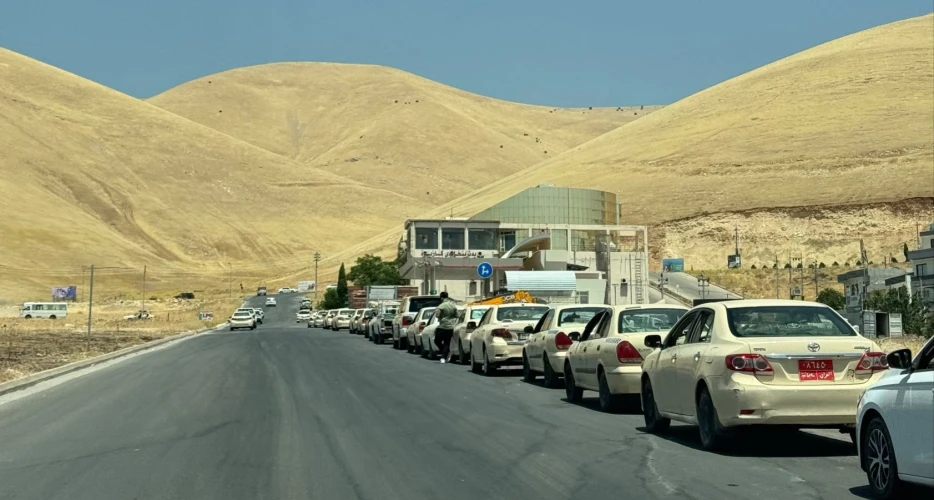
Peregraf — In a press conference held on Sunday, Peshawa Hawramani, official spokesperson for the Kurdistan Regional Government (KRG), addressed a severe domestic gasoline crisis that has triggered widespread public frustration, long queues, and private service station closures across the Kurdistan Region of Iraq.
While the spokesperson also responded to questions regarding delayed public sector salaries and electricity cuts, the critical shortage and price surge of commercial fuel dominated the briefing.
KRG Response to Fuel Shortages and Price Spikes
Addressing the ongoing fuel crunch, Hawramani claimed that high-level administrative meetings are underway to manage the crisis.
"Today, a meeting was held regarding the issue of gasoline. Yesterday a meeting was held as well, and tomorrow a high-level meeting will take place," Hawramani said. "The Kurdistan Regional Government wants to resolve this issue as quickly as possible so that the gasoline situation returns to normal and citizens... no longer face hardships due to the reduced supply of gasoline at service stations."
Hawramani stated that government officials met with local station owners and fuel traders in an effort to balance commercial profits with public interest. He claimed that KRG Prime Minister Masrour Barzani is directly supervising the response.
According to Hawramani, the KRG plans to facilitate smoother fuel transport at border crossings and checkpoints to lower market prices. However, he cautioned that a full recovery would take time due to recent demand pressures.
Key Causes and Breakdown of the Gasoline Crisis
According to findings by Bawar Jamal, President of the Aburikar Organization, the crisis stems from structural supply-demand imbalances, international trade diversions, and rising commercial import costs:
Exports to Turkey Causing Local Shortages: A primary driver of the domestic supply deficit is that refineries inside the Kurdistan Region have been exporting fuel to Turkey, where buyers pay up to 1,600 IQD ($1.07 USD) per liter. This outbound flow has diverted critical fuel supplies away from the domestic market.
Daily Consumption vs. Domestic Refining Output: The Kurdistan Region requires approximately 5 million liters of gasoline daily to meet local demand. Refining operations processing 50,000 barrels of crude per day yield roughly 3.6 million liters of gasoline daily, leaving an internal deficit of 1.4 million liters.
Commercial Import Reliance and Price Pressures: To bridge the supply gap, roughly 3 million liters of commercial gasoline are imported daily. However, a broader rise in international commercial fuel prices has sharply driven up import costs.
Proposed Remedies: Analysts emphasize that the regional government could lower market prices and resolve the shortage through key measures:
An immediate ban on fuel exports to Turkey, redirecting local refinery output to citizens at subsidized rates.
Direct supplementation of gasoline supplies by the federal government of Iraq, which is directly intertwined with requiring the KRG to hand off its management and control of the 50,000 barrels per day crude allocation.
Easing administrative burdens on commercial imports alongside government support.
Unresolved Salary Disputes with Baghdad
Regarding the delay in paying civil servant salaries for July 2026, Hawramani placed the responsibility on technical and financial disagreements with the federal Ministry of Finance in Baghdad.
"The salary list has been sent, the trial balance was sent last week, and our technical team went there," Hawramani claimed. "We asked them to conduct a review regarding the 120 billion IQD ($80 million USD) internal revenue issue, but so far they have not provided a positive response."
Power Grid Disruptions and Gas Supply
Addressing questions regarding disruptions to the "Roonaki" 24-hour electricity project, Hawramani attributed the power reductions directly to natural gas production levels. He claimed that once gas supply stabilizes, grid distribution will return to normal levels.
He concluded by announcing that another high-level KRG leadership meeting is scheduled for Monday, July 27, where additional government decisions regarding fuel regulation and power grid restoration are expected to be formalized.
Regional Security and the US War on Iran
Commenting on cross-border strikes impacting the Kurdistan Region within the broader context of the US War on Iran, Hawramani reiterated the KRG’s stance that local territory should not be targeted or drawn into external conflicts.
"We repeat the same statement we previously communicated directly and publicly announced: these are unjustified attacks on the Kurdistan Region," Hawramani said. "The Kurdistan Region is not part of this problem, nor part of these issues."
He emphasized that civilian areas should not face bombardment over alleged pretexts. "From the beginning, we were not part of this war; we were neither against anyone nor supporting anyone. We wanted peace and were not aligned with any side," he claimed.