PM Barzani Calls Baghdad’s 50,000-Barrel Fuel Allocation 'Unfair' Amid Gasoline Crisis
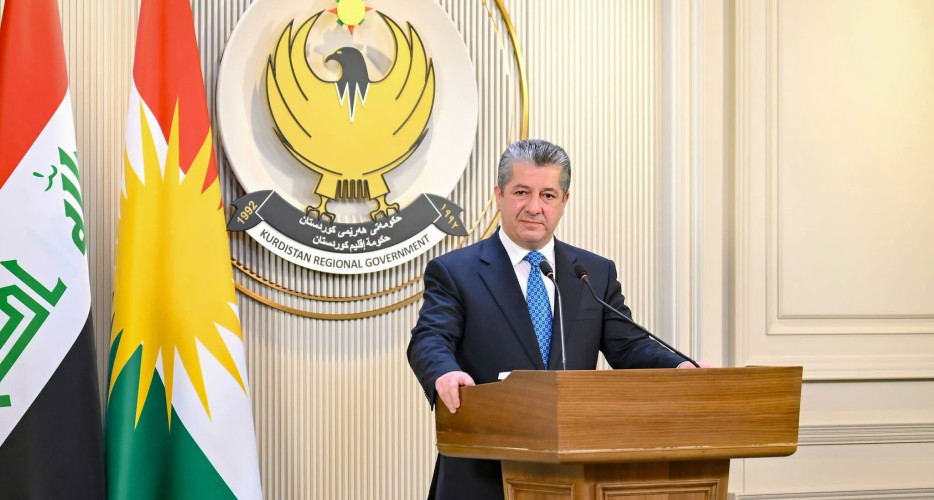
Peregraf — Kurdistan Regional Government (KRG) Prime Minister Masrour Barzani said on Monday that Baghdad’s allocation of 50,000 barrels of crude oil per day for the Kurdistan Region’s domestic fuel needs is “unfair,” arguing that the region should receive 126,700 barrels based on its share of Iraq’s population.
Speaking at a press conference in Erbil, Barzani said the Iraqi government allocates one million barrels of oil per day for domestic consumption nationwide. Based on the Kurdistan Region’s 12.67% share, he said, the region should receive approximately 126,700 barrels per day instead of the current allocation.
“Providing only 50,000 barrels of oil for domestic needs was imposed and is unfair,” Barzani said.
His remarks came as the Kurdistan Region continues to grapple with a worsening gasoline crisis that has triggered long queues at subsidized filling stations, widespread shortages in some provinces, and growing public frustration despite recently imposed government price ceilings.
Barzani said the KRG held a “detailed meeting” on Monday with the Ministry of Natural Resources and other relevant officials to discuss the fuel situation but did not announce any new measures to address the shortages or rising prices.
On relations with Baghdad, the prime minister said coordination between the two governments had improved.
“Currently, in all areas, we have greater coordination with Baghdad, and we are satisfied and pleased with our relations with Baghdad,” he said.
Addressing the Kurdistan Region’s political deadlock, Barzani also called for parliament to resume its work and urged political parties to form an inclusive government.
“Parliament must be reactivated, and an all-inclusive government must be formed,” he said.
The gasoline crisis has persisted despite a July 22 decision by the KRG Ministry of Natural Resources imposing new maximum retail prices. The ministry capped commercially sold regular gasoline at 850 Iraqi dinars (IQD) per liter, Muhassan at 1,000 IQD, and Super gasoline at 1,200 IQD, while maintaining the subsidized price of regular gasoline at 750 IQD per liter.
A Peregraf survey found the measures have produced sharply different outcomes across the Kurdistan Region.
In Erbil and Duhok, many filling stations have run out of gasoline after refusing to sell fuel at government-mandated prices that operators say would leave them operating at a loss.
In Sulaymaniyah and Halabja, however, the price caps have largely gone unenforced. Fuel remains available, but motorists continue paying around 1,250 IQD per liter for regular gasoline, 1,350 IQD for Muhassan, and 1,500 IQD for Super gasoline.
Meanwhile, government-subsidized gasoline remains available at only a limited number of stations, where motorists often wait for hours—or overnight—to buy fuel at the official price of 750 IQD per liter.
The dispute has also reached Iraq’s federal parliament, where a seven-member investigative committee is examining the KRG’s management of the 50,000-barrel-per-day allocation. Lawmakers argue that residents of the Kurdistan Region should have access to subsidized gasoline at 450 IQD per liter, the same price available across federal Iraq.
The KRG has not publicly responded to the parliamentary investigation or to opposition allegations that politically connected refineries have benefited from the current pricing system.