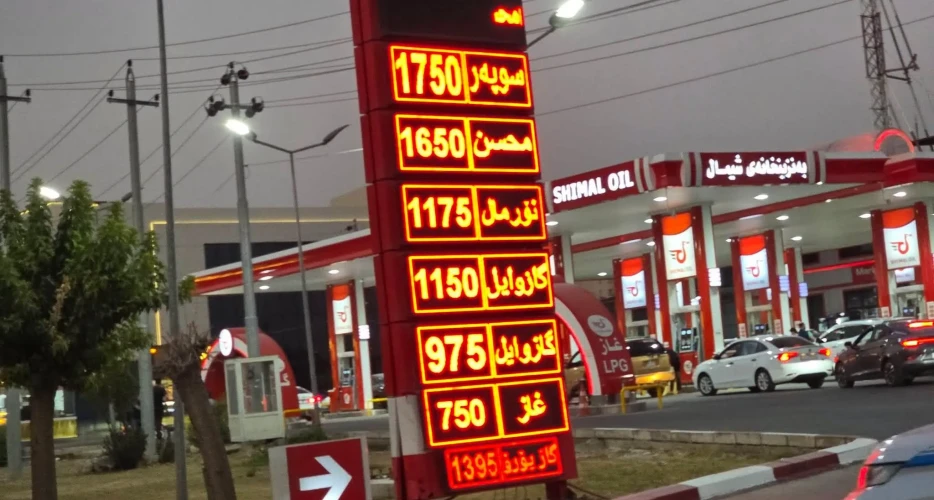
Peregraf - The Kurdistan Regional Government (KRG) has shifted its approach to tackling the Kurdistan Region's gasoline crisis after efforts to cap commercial fuel prices failed to stabilize the market.
Over the past week, the KRG has moved away from enforcing maximum prices for commercial gasoline and instead focused on expanding supplies of government-subsidized fuel, monitoring commercial markets, facilitating imports and seeking a larger crude oil allocation from Baghdad.
Despite the policy shift, Peregraf found that government-subsidized gasoline remains difficult to obtain across the Kurdistan Region, forcing most motorists to rely on significantly more expensive commercial fuel. With the average monthly household income estimated at about $400 (600,000 IQD), higher fuel prices have increased the financial burden on many families.
The KRG first intervened on July 20, announcing that government-subsidized Regular gasoline would remain priced at 750 IQD ($0.50) per liter, while commercial Regular gasoline could not exceed 850 IQD ($0.57).
Two days later, the Ministry of Natural Resources expanded the order by capping all commercial grades at 850 IQD ($0.57) for Regular, 1,000 IQD ($0.67) for mid-grade (Muhassan) gasoline and 1,200 IQD ($0.80) for Super gasoline.
The policy quickly encountered resistance. Filling station operators argued they were purchasing commercial gasoline above the government's price ceilings, making compliance financially unsustainable. Many stations in Erbil and Duhok stopped selling commercial Regular gasoline or removed prices for some grades altogether.
By July 28, the KRG had noticeably changed its public messaging. Instead of emphasizing price ceilings, the Ministry of Natural Resources announced a five-point plan centered on increasing supplies of subsidized gasoline, monitoring commercial prices and fuel quality, expanding inspections, facilitating imports and seeking a larger crude oil allocation from Baghdad. Although officials said commercial prices would continue to be monitored, they no longer explicitly instructed stations to sell fuel at the earlier capped prices.
The gasoline shortage has also become intertwined with the dispute between Erbil and Baghdad over domestic fuel allocations.
Speaking on July 27, KRG Prime Minister Masrour Barzani said Baghdad's allocation of 50,000 barrels of crude oil per day for the Kurdistan Region's domestic fuel needs is insufficient. He argued that because the Kurdistan Region accounts for 12.67 percent of Iraq's population, it should receive approximately 126,700 barrels per day rather than the current allocation. According to the KRG, a larger allocation would allow greater production of subsidized gasoline and reduce dependence on expensive commercial imports.
Peregraf's survey of filling stations across Erbil, Sulaymaniyah, Halabja and Duhok found that the central problem is no longer the government's announced prices but the limited availability of subsidized gasoline.
Government-subsidized Regular gasoline priced at 750 IQD ($0.50) remains available only at selected stations, where motorists frequently wait for hours—and sometimes overnight—to purchase fuel. Most drivers instead buy commercial gasoline at market prices.
In Erbil, commercial gasoline was selling for 1,150–1,350 IQD ($0.77–$0.90) per liter for Regular, 1,300–1,700 IQD ($0.87–$1.13) for mid-grade gasoline and 1,750–1,850 IQD ($1.17–$1.23) for Super gasoline. Several stations displayed no price for Regular gasoline, indicating it was unavailable.
In Sulaymaniyah and Halabja, Peregraf recorded average prices of about 1,150 IQD ($0.77) for Regular, 1,350 IQD ($0.90) for mid-grade gasoline and 1,500 IQD ($1.00) for Super gasoline. Subsidized gasoline remained available only through designated stations.
In Duhok, where station operators argued the government price ceilings were economically unsustainable, commercial gasoline sales resumed after discussions with local authorities. Peregraf found Regular gasoline selling for 1,250–1,300 IQD ($0.83–$0.87), mid-grade gasoline for 1,400–1,500 IQD ($0.93–$1.00) and Super gasoline for 1,500–1,550 IQD ($1.00–$1.03) per liter.
The crisis has also drawn political criticism. Opposition lawmaker Kawa Ali Kareem questioned the KRG's account of the crude oil allocation dispute with Baghdad and challenged official explanations regarding production costs and refinery profits. Separately, Halwest (National Stance Movement) lawmaker Ali Hama Saleh published photographs showing commercial Regular gasoline selling for 900 IQD ($0.60) per liter despite earlier government price controls. Those claims have not been independently verified by Peregraf.
Meanwhile, Iraq's federal parliament has launched an investigation into the KRG's management of the 50,000-barrel-per-day crude oil allocation designated for domestic fuel production.
For now, the KRG has shifted from emphasizing commercial price controls to increasing subsidized fuel supplies, expanding imports and seeking more crude oil from Baghdad. Whether those measures will improve fuel availability remains uncertain.
Across much of the Kurdistan Region, the reality remains unchanged: government-subsidized gasoline priced at 750 IQD ($0.50) per liter remains difficult to obtain, while most motorists continue relying on considerably more expensive commercial fuel.