Turkey’s Proposed 'Framework Law' Unveiled as Bahçeli Calls for Demirtaş's Release and Öcalan's 'Right to Hope'
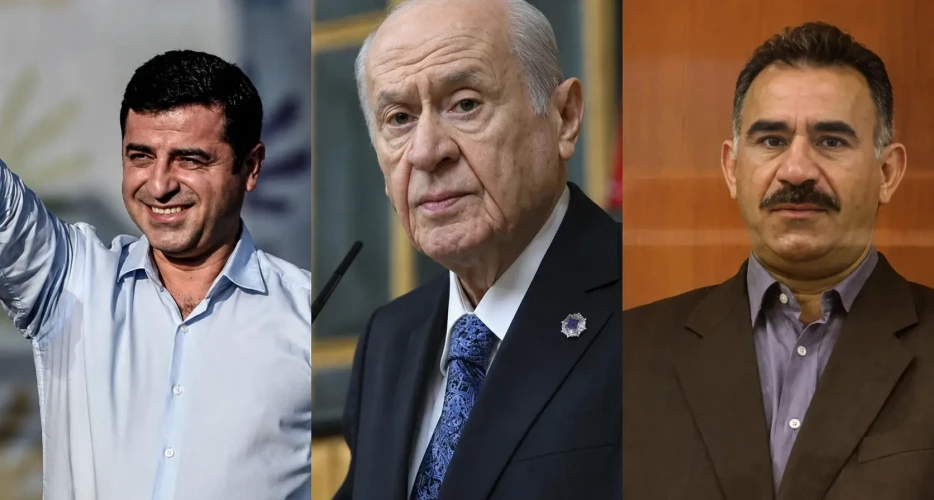
Peregraf - Following the submission of a 12-article draft framework bill to the Turkish Parliament bearing the signatures of nearly 360 lawmakers, Nationalist Movement Party (MHP) Chairman Devlet Bahçeli issued statements regarding the ongoing process.
Speaking to the press, Bahçeli revealed that he maintains regular contact with imprisoned former Peoples' Democratic Party (HDP) co-chair Selahattin Demirtaş through his attorneys. "We have good mutual relations. I ask after his health, and he sends his regards. I also inquire if he has any requests. We worked together in the Turkish Parliament. I am saying the same thing again: Selahattin Demirtaş should return to his home, the Ahmets should return to their duties, and Öcalan should be granted the 'right to hope'. Turkey must find peace; our goal is peace for Turkey and the region," Bahçeli said.
Regarding the draft legislation, Bahçeli added: "May this signature we have affixed bring good fortune. With this signature, our thousand-year brotherhood has been registered once again. Everyone has won—whether Turk or Kurd, regardless of language or identity. All 86 million citizens and the peoples of the Middle East have won. At the same time, the first step toward thwarting global projects targeting the region has been taken. On this occasion, I extend my gratitude to Mr. President and Mr. Speaker of the Parliament."
Addressing questions regarding his recent speeches, the MHP leader stated: "Sometimes people ask us why we do not mention the 'Terror-Free Turkey' process in our recent group speeches. We observe state etiquette. Our President is closely following the process, and our Speaker of the Parliament is overseeing the matter. We support them. It is not right to get ahead of the work they are leading."
AKP Group Chairman Abdullah Güler announced that the 12-article draft bill sets out the legal and administrative structure for the "Terror-Free Turkey" initiative.
Key Points of the Bill:
-
Prerequisites for Implementation: The provisions will take effect only after security institutions confirm that the PKK/KCK and its affiliated entities have permanently ceased their physical presence and surrendered all weapons, followed by an official declaration by the National Security Council (MGK) published in the Official Gazette.
-
Scope: Covers offenses related to establishing, managing, or being a member of the PKK/KCK, aiding the organization, spreading propaganda, and financing terrorism.
-
Exclusions: Intentional manslaughter committed within the scope of organizational activities, as well as crimes committed before June 1, 2005, that carry life or aggravated life sentences, are strictly excluded from the scope of the deferrals.
-
Deferral Periods: For covered offenses carrying a maximum sentence of 15 years or less, investigations, prosecutions, and execution of sentences are deferred for 5 years. For offenses carrying sentences exceeding 15 years or life imprisonment, deferrals are set at 10 years. If no terrorism offenses are committed during the deferral period, the charges or sentences are effectively dropped.
-
Oversight and Coordination: A Board chaired by the Vice President—comprising the Ministers of Justice, Foreign Affairs, Interior, and National Defense, alongside the Chief of Staff, MİT Director, and MGK Secretary-General—will oversee the process. Parliament will also establish a dedicated Monitoring Commission.
-
Application Period: Eligible individuals must submit a written request to public prosecutor's offices or designated board institutions within six months of the MGK decision being published.
Full Text of the Draft Law
PROPOSAL FOR A LAW ON STRENGTHENING NATIONAL SOLIDARITY AND SOCIAL INTEGRATION
Purpose and Scope
ARTICLE 1–
(1) The purpose of this Law is to determine the procedures regarding the deferral of ongoing investigations, prosecutions, and the execution of convictions, as well as other measures to be taken, following the official determination by security institutions—and its subsequent confirmation via a National Security Council Decision published in the Official Gazette—that the PKK/KCK terrorist organization and all its affiliated entities have terminated their physical existence and surrendered all weapons and ammunition under their control.
(2) The provisions of this Law cover the offenses of establishing or managing the PKK/KCK terrorist organization, becoming a member, knowingly and willingly aiding the organization, making propaganda for the organization, offenses committed within the framework of the organization's activities, and offenses regulated under Law No. 6415 on the Prevention of the Financing of Terrorism committed in favor of the organization.
Definitions
ARTICLE 2–
(1) In this Law:
a) Organization: Refers to the PKK/KCK terrorist organization and all its affiliated entities.
b) Board: Refers to the Board to be established pursuant to Article 7 of this Law.
Deferral of Investigations and Prosecutions
ARTICLE 3–
(1) Provided that the National Security Council Decision confirming the termination of the organization's physical existence and the surrender of its weapons is published in the Official Gazette, investigations and prosecutions for offenses falling under Article 1 carrying a maximum penalty of 15 years or less shall be deferred for five years. Investigations and prosecutions for offenses carrying a penalty of more than 15 years, life imprisonment, or aggravated life imprisonment shall be deferred for ten years.
Exclusions: Intentional manslaughter committed within the framework of organizational activities and offenses committed prior to June 1, 2005, requiring life or aggravated life imprisonment are excluded. The statute of limitations shall not run during the deferral period.
(2) Decisions rendered by public prosecutors pursuant to the first paragraph may be appealed to the peace judiciary within two weeks. Court decisions regarding the deferral of prosecution may likewise be appealed within two weeks.
(3) Investigations initiated after the publication of the MGK Decision for offenses committed prior to the decision shall require the explicit authorization of the Board.
Protective Measures and Files Under Judicial Review
ARTICLE 4–
(1) Protective measures regarding arrest and judicial control issued for offenses subject to deferral under Article 3 shall be evaluated by the competent judge or court, and such measures shall be lifted where conditions are met.
(2) Case files currently before regional appellate courts or the Court of Cassation (Yargıtay) subject to deferral under Article 3 shall be issued reversal (bozma) decisions.
Registration of Deferral Decisions and Recidivism
ARTICLE 5–
(1) Deferral decisions granted under Article 3 shall be recorded in a dedicated system.
(2) If a terrorism offense is committed within the deferral period, the deferral decision shall be revoked and proceedings resumed. If the deferral period passes without the commission of a new terrorism crime, a decision of non-prosecution (nolle prosequi) or dismissal shall be rendered.
Deferral of Execution of Sentences
ARTICLE 6–
(1) Under the condition of the MGK Decision being published in the Official Gazette, sentences for convicts serving 15 years or less shall be deferred for 5 years; sentences exceeding 15 years or life imprisonment shall be deferred for 10 years by order of the execution judge (excluding intentional manslaughter and pre-2005 life sentence convictions).
(2) Appeals may be lodged against deferral decisions issued by the execution judge.
(3) Deferral decisions shall be recorded in the system specified in Article 5.
(4) If a terrorism crime is committed during the deferral period, the execution judge shall revoke the deferral. If the period passes without offense, the sentence shall be deemed fully served.
Follow-up, Coordination, and Implementation
ARTICLE 7–
(1) Follow-up and evaluation of activities under this Law shall be conducted by a Board chaired by the Vice President, composed of the Minister of Justice, Minister of Foreign Affairs, Minister of Interior, Minister of National Defense, Secretary-General of the Presidency, Director of the National Intelligence Organization (MİT), and Secretary-General of the National Security Council (MGK).
(2) The Board may assign sub-commissions to oversee progress.
(3) The Board shall periodically evaluate the complete dissolution of the organization based on observation reports.
(4) Upon evaluation, the Board may request the competent judicial authorities to remove all legal disabilities (hak yoksunluğu) resulting from investigations, prosecutions, or convictions.
(5) The Board shall regularly inform the Grand National Assembly of Turkey. A Monitoring Commission shall be established within the TBMM to oversee activities.
(6) Secretariat services for the Board shall be provided by the Secretary-General of the Presidency.
Surrender of Weapons and Equipment
ARTICLE 8–
(1) Weapons, ammunition, vehicles, equipment, explosives, and materials brought or declared by organization members shall be officially registered.
(2) Principles regarding implementation shall be jointly determined by the Ministry of Interior and Ministry of National Defense upon consulting security agencies.
Time Limit for Application
ARTICLE 9–
(1) Provisions of this Law shall apply to individuals who submit a written application to public prosecutor's offices or designated Board institutions within six months following the publication of the MGK Decision in the Official Gazette.
Duties and Immunities
ARTICLE 10–
(1) Duties assigned under this Law shall be executed urgently by relevant public institutions.
(2) Individuals executing duties assigned within the scope and objectives of this Law shall bear no legal, administrative, or criminal liability for such duties.
Enforcement and Execution
ARTICLE 11– This Law enters into force on the date of its publication.
ARTICLE 12– The President of the Republic executes the provisions of this Law.
General Justification (Statement of Purpose)
The general justification emphasizes that the fundamental duty of the state is to preserve national independence, territorial integrity, public order, and social peace.
It states that as Turkey enters the second century of the Republic, a new security and judicial perspective is required—one that treats security, democracy, and the rule of law as complementary elements. The document notes that a "Terror-Free Turkey" will allow state resources previously allocated for security to be directed toward education, science, technology, production, and infrastructure.
Furthermore, the justification explicitly notes that the bill is not a general amnesty and does not eliminate criminal guilt or alter the legal nature of past offenses. Instead, it offers a conditional, limited judicial frame aimed at societal integration ("Turkey Model") following the full verification of disarmament and dissolution of the organization.