Iraqi Oil Minister Says KRG Chose Its Own Crude Allocation as Erbil Gasoline Hits 2,390 Dinars per Liter
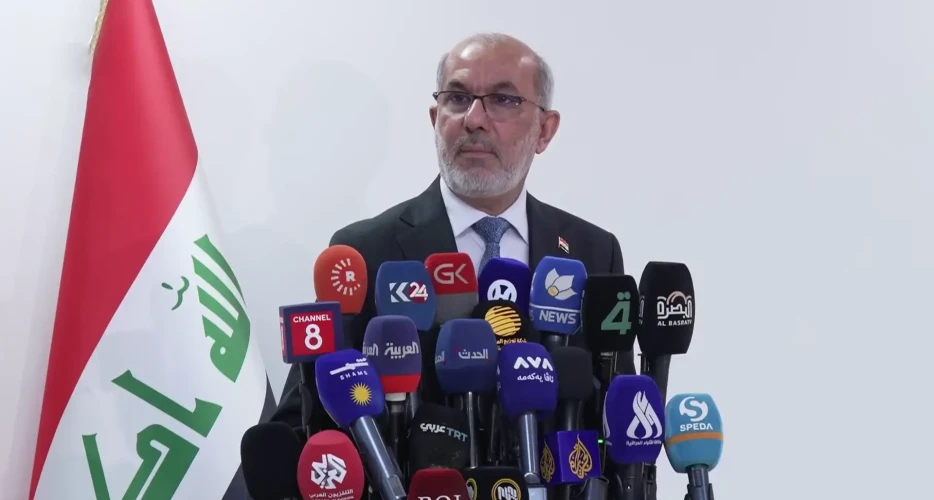
Peregraf - Iraq's Oil Minister Bassem Mohammed Khudhair al-Abadi told reporters in Baghdad on August 8 that fuel price differences in the Kurdistan Region trace back to a tripartite agreement between the federal Ministry of Oil, the Kurdistan Regional Government (KRG), and oil companies operating in the Kurdistan Region, under which the KRG opted to receive crude oil directly rather than subsidized fuel products from Baghdad. The comments came as gasoline prices at pumps in Erbil reached as high as 2,390 dinars per liter the same day, far above the federally subsidized prices charged elsewhere in Iraq, where Normal-grade gasoline sells for 450 dinars per liter and Muhassan (mid-grade) sells for 850 dinars per liter.
A reporter at the press conference told al-Abadi that gasoline prices in the Kurdistan Region had reached 1,500 dinars per liter in some areas — a figure now exceeded by prices recorded in Erbil, where a local station listed premium-grade "Super" gasoline at 2,390 dinars, "Muhassan" (mid-grade) at 2,190 dinars, "Normal" gasoline at 1,695 dinars, and diesel (gasoil) at 1,390 dinars per liter. By comparison, Normal-grade gasoline in the rest of Iraq costs less than a third of the Erbil price, and Muhassan-grade gasoline in Erbil costs roughly two-and-a-half times the federal rate. The reporter asked whether the Ministry of Oil intends to supply gasoline to the Kurdistan Region to address the shortage, and separately asked about a dispute between Dana Gas and the KRG over gas supply to power stations.
At the prevailing exchange rate of roughly 1,500 dinars to the US dollar, the Erbil prices translate to about $1.59 per liter for Super gasoline, $1.46 for Muhassan (mid-grade), $1.13 for Normal gasoline, and $0.93 for diesel — compared to roughly $0.30 per liter for Normal gasoline and $0.57 per liter for Muhassan gasoline under the federally subsidized price. For a household with the Kurdistan Region's average income of roughly $400 per month, filling a standard 50-liter tank with Normal-grade gasoline at Erbil prices — roughly 84,750 dinars, or $56.50 — would consume more than 14 percent of a family's total monthly income, compared to about $15 for the same tank at the federal price.
Responding to the question on fuel prices, al-Abadi said the previous federal government had succeeded in signing a tripartite agreement between the Ministry of Oil, the Kurdistan Regional Government, and companies operating in the Kurdistan Region, which he described as an achievement given that no such agreement had previously existed. Under that agreement, he said, the ministry spoke candidly with officials in the KRG, who requested an allocation of 50,000 barrels per day of crude oil for internal consumption because the Kurdistan Region operates its own refineries.
Al-Abadi said the ministry told the KRG directly that the 50,000 barrels it receives are barrels the federal government would otherwise export, and that as the Ministry of Oil, it is responsible for supplying oil products — gasoline and gas oil — at prices the ministry calculates across all of Iraq's governorates. He said the KRG held its own position: that it would take on responsibility for providing these products to citizens itself, in exchange for receiving the 50,000-barrel allocation. That arrangement, he said, was the vision agreed upon in the tripartite agreement, and it remains open to amendment through negotiation between the federal government and the Kurdistan Region's government.
"We do not differentiate between a citizen in Kurdistan and a citizen in the south, center, or west," al-Abadi said, adding that the suffering of citizens in the Kurdistan Region is shared by the federal government. He said the Kurdistan Region's file requires extensive dialogue to reach final agreements, and that he believes a federal oil and gas law is the only framework capable of providing a complete solution to the dispute.
Al-Abadi added that the KRG had separately had a need regarding cooking gas (LPG), which the ministry supplied. He said that if the ministry had additional quantities of gasoline and gas oil available and had planned for them, it would not hesitate to support the Kurdistan Region. However, he stressed that the current arrangement — receiving 50,000 barrels of crude while taking charge of providing gasoline and other products to citizens itself — was, in his words, "decisively and exclusively" the Kurdistan Region's own decision.
Asked separately whether the KRG's share of crude oil would be increased to meet the Kurdistan Region's needs, al-Abadi said the matter is under discussion and that he expects a resolution "in the coming days," describing it as not a difficult issue to resolve.
The question on the Dana Gas dispute with the KRG over power-station gas supply went unaddressed in the minister's response, which focused on the crude allocation issue.
Another reporter asked about compensation for foreign companies operating in the Kurdistan Region that have halted production due to repeated attacks on the Kurdistan Region during the war. Al-Abadi said the government would compensate companies for losses proven to result from domestic violations, but said it has no authority over strikes originating from outside Iraq, and that the government rejects any assault on companies operating in the country.
Hormuz disruption cuts Iraqi exports by up to 75 percent
Al-Abadi also addressed the broader impact of the regional war on Iraq's oil sector, saying exports through the Strait of Hormuz have fallen sharply since the conflict began. He said Iraq exported roughly 106 million barrels per month before the war, compared to about 22 million barrels in the sixth month of the crisis and roughly 42 million barrels in the most recent month, the highest monthly total since the disruption began. He attributed the fluctuation to tankers' willingness to enter Iraqi waters and to insurance costs tied to the security situation, and said talks are underway with Iran on allowing safer passage, though no agreement has been finalized.
Despite the export decline, al-Abadi said the ministry has kept domestic supply of gasoline, gas oil, and white oil stable, and that consumption has in fact increased compared to pre-war levels.
New US energy deals and a $15 billion pipeline bypassing Hormuz
The minister detailed a series of agreements signed during a recent visit to the United States alongside the prime minister, which he described as opening a new chapter in Iraq's oil sector. Chevron signed an addendum covering the West Qurna 2 field, which Lukoil had exited, as well as an agreement on the Nassiriya project and four exploration blocks. HKN Energy signed a contract to develop the Hamrin field, and Halliburton signed on to develop the Nahr Bin Umar and Sindbad fields. BP and ConocoPhillips signed memorandums of understanding covering exploration blocks in northern Iraq, and three US companies signed a memorandum covering the Akkas field and other exploration areas. Al-Abadi said the combined projects are expected to bring more than $200 billion in investment.
Separately, Iraq signed an agreement with a consortium of Chevron, TI, and Qatar's UCC to build a new pipeline linking Basra to Fishkhabur in the north, with a branch running from Haditha to Baniyas in Syria, under a Build-Own-Operate-Transfer (BOOT) structure in which the consortium would fund and operate the pipeline for 20 to 25 years before ownership transfers to the Iraqi state. Al-Abadi put the project's cost at no less than $15 billion and said it is designed to carry more than 2 million barrels per day, reducing Iraq's dependence on the Strait of Hormuz for exports.
On the separate export agreement with Turkey, al-Abadi said a one-year deal signed with Botas will sustain exports through Ceyhan at a planned 750,000 barrels per day, eventually rising toward a target of 1.5 million barrels per day. He said Kirkuk's current production of roughly 380,000 barrels per day is fully consumed by domestic refineries and cannot alone supply the volume committed to Turkey, and that the shortfall would be met through increased production in the Kurdistan Region, expanded tanker-truck transport from Basra, and rehabilitation work on the strategic Basra-Haditha-K3 pipeline route.