DEM Party, PKK Leadership Send Dueling Messages to Turkish Parliament Ahead of Framework Law Vote
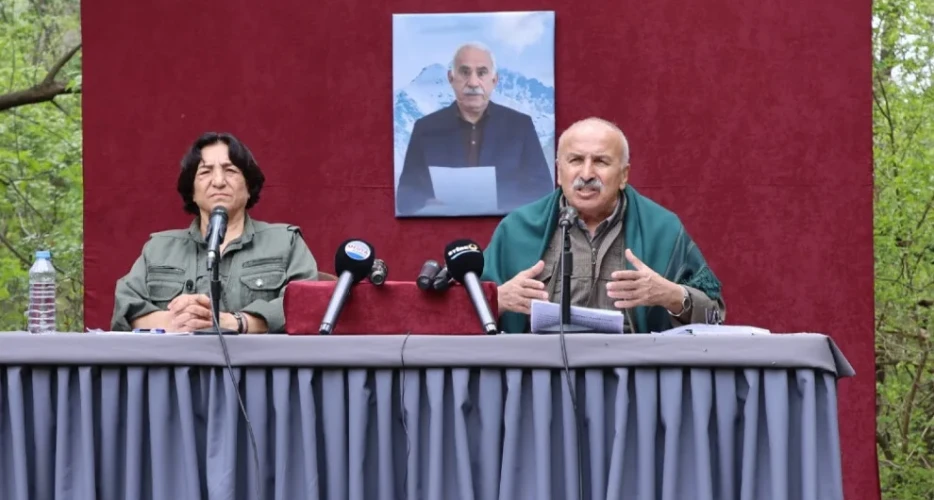
Peregraf — With Turkey's long-awaited "framework law" governing the disarmament and reintegration of the outlawed Kurdistan Workers' Party (PKK) set for a floor vote in the Turkish Grand National Assembly, two of the process's key actors issued public messages on Sunday laying out sharply different tones toward the legislation: a conciliatory appeal from jailed former DEM Party co-chair Selahattin Demirtaş and Diyarbakır's ousted co-mayor Selçuk Mızraklı, and a more critical assessment from the PKK's post-dissolution leadership body, the Hareket Yönetimi — literally "Movement Administration" in Turkish, and the successor body to the group's former central committee following its formal dissolution.
The bill, officially titled the "Draft Law on Strengthening National Solidarity and Social Cohesion," is the central piece of legislation meant to give legal footing to Turkey's two-year-old peace process with the PKK. The process began after PKK founder Abdullah Öcalan, imprisoned on İmralı Island, called on the group in February 2025 to convene a congress, disarm and dissolve. The PKK formally announced the end of its armed struggle in May 2025 and staged a symbolic weapons-destruction ceremony in the Kurdistan Region in July 2025, later withdrawing fighters from Turkish territory to bases in Iraq.
The framework law, carrying more than 360 signatures from lawmakers across the ruling Justice and Development Party (AKP), the Nationalist Movement Party (MHP), the pro-Kurdish DEM Party and the Republican People's Party (CHP), was submitted to parliament earlier this month and cleared the Justice Committee after roughly 17 hours of debate that ran from Friday, August 7 into the early hours of Saturday, August 8. It is scheduled to reach the General Assembly floor on Monday, August 10, with a final vote possible before parliament enters summer recess. The bill provides for the suspension of certain criminal investigations and court proceedings tied to PKK membership for periods of five to ten years and establishes new oversight bodies — one under the presidency and one within parliament — to manage the disarmament and reintegration process. Even if passed, the law would still require presidential approval, publication in the Official Gazette, and a subsequent determination by Turkey's National Security Council that the PKK has fully disbanded and disarmed before taking effect.
DEM Party co-chairs' message: a call for unity
In a message addressed to the General Assembly and read out ahead of the vote, Demirtaş and Mızraklı described the legislation as a step in "a historic peace effort" capable of reshaping the country's and the region's future. The two — both former DEM Party figures who have faced lengthy legal battles, with Demirtaş having spent years in pretrial detention — struck a notably conciliatory tone, urging lawmakers to treat the process not as a matter of division or transactional bargaining but as a shared national undertaking.
They acknowledged that the bill would draw criticism and proposed amendments, calling such input valuable, but appealed to parliamentarians to cast their votes "in a way that strengthens our peace, unity and brotherhood." The message thanked a long list of political figures involved in the process, including President Recep Tayyip Erdoğan, MHP leader Devlet Bahçeli, Parliament Speaker Numan Kurtulmuş, CHP figures, and Öcalan himself, whom they credited with "great effort for peace." It also singled out DEM Party co-chairs Tuncer Bakırhan and Tülay Hatimoğulları and the party's İmralı delegation, and paid tribute to the late Sırrı Süreyya Önder, a DEM Party figure closely associated with the peace effort who has since died.
PKK leadership: law "carries serious errors and shortcomings"
In a separate statement carried the same day, the PKK's leadership body — the Hareket Yönetimi (Movement Administration), formed to represent the group after its formal dissolution — offered a more guarded response. While acknowledging that the framework law had cleared the Justice Committee with broad political backing, the statement said the text "carries serious errors and shortcomings" and criticized the commission report underlying it for failing to reflect recommendations on democratization and a resolution of the Kurdish question.
The statement objected in particular to language in the bill that it said addressed disarmament without explicitly naming the Kurdish issue, calling this evidence that the matter was not being handled comprehensively. It reiterated the group's longstanding position that implementation of the law depends on Öcalan being able to live and work freely, and specifically on his taking a coordinating role in the process — a role the statement said MHP leader Bahçeli had himself proposed but which remains undefined in the bill's text. "This law can only be implemented if the practice is carried out and managed by Rêber Apo," the statement said, using the honorific commonly applied to Öcalan by the movement.
The statement also called for the law to be treated as a starting point rather than an endpoint, saying further democratization legislation should follow "without delay" to address freedom of thought and organization. It closed by urging Kurdish communities and democratic forces to keep organizing and pressing for a resolution of the Kurdish question, arguing that only under those conditions would the legislation fulfill its intended role as a genuine framework law.
What comes next
The contrast between the two messages — one urging parliament toward unity and swift passage, the other flagging unresolved conditions tied to Öcalan's status — reflects a broader dynamic that has shaped the process for months: while the Turkish government, DEM Party, Öcalan and the PKK's post-dissolution leadership broadly agree that the conflict has ended and must now be resolved through parliament and law, they remain divided over how far the legislation should go beyond disarmament and verification. The bill's next test comes Monday, August 10, when the Turkish Grand National Assembly opens floor debate in its General Assembly. Opposition from nationalist İYİ Party lawmakers is expected, but is not seen as sufficient to block passage given the scale of cross-party backing the bill has secured.