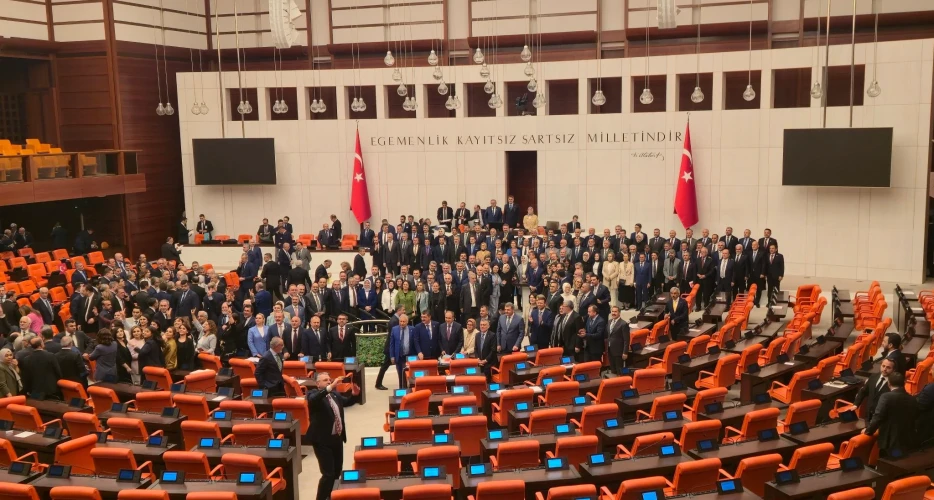
Peregraf — Turkey's parliament passed a law on Monday establishing a legal framework for the disbandment of the outlawed Kurdistan Workers' Party (PKK), marking the most concrete legislative step yet in a two-year effort to end a conflict that has killed more than 40,000 people since 1984.
The bill, formally titled the Law on Strengthening National Solidarity and Social Integration, was approved in the General Assembly of the Turkish Grand National Assembly after roughly 12 hours of debate, passing 468 to 88 with 6 abstentions in the 600-seat chamber. Backing came from across most of the political spectrum, including the ruling Justice and Development Party (AKP), its nationalist ally the Nationalist Movement Party (MHP), the pro-Kurdish DEM Party, and the main opposition Republican People's Party (CHP). Party leaders casting votes included MHP chairman Devlet Bahçeli, DEM Party co-chairs Tuncer Bakırhan and Tülay Hatimoğulları, CHP leader Özgür Özel, İYİ Party leader Müsavat Dervişoğlu, and the heads of the Saadet Party, the Democratic Left Party, HÜDA PAR and the Workers' Party of Turkey. Yeniden Refah Party leader Fatih Erbakan was a notable exception, announcing his party would abstain (see "Parliamentary debate" below).
The legislation provides legal protections for many former PKK members who have not committed specific crimes and facilitates the suspension of prison sentences for some individuals convicted of PKK membership, opening a path for their reintegration into civilian life.
Background to the vote
The law is the most tangible outcome so far of a process that began publicly in October 2024, when MHP leader Bahçeli — long associated with a hardline stance against Kurdish militancy — unexpectedly suggested that jailed PKK founder Abdullah Öcalan could address parliament and announce the group's dissolution. Öcalan, imprisoned on İmralı Island since 1999, called on the PKK in February 2025 to convene a congress, disarm and disband. The PKK announced in May 2025 that it would end its armed struggle and dissolve its structures, and a group of fighters symbolically destroyed their weapons at a ceremony in the Qandil mountains in the Kurdistan Region two months later.
A parliamentary commission established in August 2025 spent months hearing from politicians, officials, civil society representatives and others before recommending the legislation now signed into law. The bill had cleared the Justice Committee on Friday, August 7, after roughly 17 hours of debate, and carried more than 360 lawmaker signatures before reaching the floor.
The PKK, designated a terrorist organization by Turkey, the United States and the European Union, launched its insurgency in 1984. The conflict imposed a heavy economic toll on the mainly Kurdish southeast of Turkey and fueled decades of political and social division.
What the law covers
The legislation applies to a defined set of offenses: founding or leading the PKK/KCK, membership, knowingly and willingly assisting the organization, producing its propaganda, other crimes committed in connection with its activities, and offenses under Turkey's terrorism-financing law committed on the organization's behalf. Deliberate killing carried out in connection with the organization's activities is excluded from the law's protections, as are life or aggravated life sentences for offenses committed before June 1, 2005.
For those convicted of qualifying offenses, prison sentences of 15 years or less will have their enforcement deferred for five years by order of an enforcement judge; sentences exceeding 15 years, along with life and aggravated life sentences, will be deferred for ten years. The same deferral periods apply to ongoing investigations and prosecutions rather than final convictions. Statutes of limitation are suspended during the deferral period, and case files and evidence must be preserved throughout. Anyone subject to a deferral decision may appeal it within two weeks.
Deferrals take effect only after Turkey's National Security Council formally determines — and publishes in the Official Gazette — that the PKK/KCK and affiliated structures have ended their operational existence and surrendered all weapons and ammunition under their control. Investigations into qualifying offenses committed before that publication date, but not yet opened, will require the oversight council's authorization to proceed. If a person under a deferral commits a new terrorism offense during the deferral period, the deferral is revoked and enforcement or prosecution resumes; if the period passes without a new offense, the case is closed or the sentence considered served.
People seeking to benefit from the law must notify prosecutors or a designated authority in writing within six months of the National Security Council's determination being published.
Oversight and weapons handover
Once the determination is published, a council chaired by a vice president — including the justice, foreign affairs, interior and defense ministers, the presidential general secretary, the head of the National Intelligence Organization, and the National Security Council's secretary-general — will oversee and evaluate implementation, with authority to form subcommittees and summon officials as needed. The council must report regularly to parliament, and a separate Monitoring Committee will be established under the parliamentary speaker's office to track the law's implementation and issue recommendations.
Weapons, ammunition, vehicles, equipment, explosives and other materials that organization members bring with them or declare will be formally logged, under procedures the interior and defense ministries are to set in consultation with security institutions.
Parliamentary debate
During floor debate, Yeniden Refah Party leader Fatih Erbakan argued the matter should be put to a referendum, saying decisions involving PKK/KCK members should rest with the families of fallen soldiers, veterans and the public at large; his party cast an abstaining vote. Parliamentary Deputy Speaker Celal Adan, presiding over the vote, credited MHP leader Devlet Bahçeli and President Erdoğan for the "terror-free Turkey" effort and thanked lawmakers before closing the session. Parliament then adjourned for recess, with its next session set for Thursday, October 1 at 14:00.
What the law does not resolve
The legislation does not by itself address broader Kurdish demands for expanded political and cultural rights, changes to Turkey's anti-terrorism laws, or the legal status of Öcalan, who remains imprisoned. In statements issued the day before the vote, both DEM Party figures and the PKK's post-dissolution leadership body, the Hareket Yönetimi, had flagged this gap: the PKK leadership body said the bill "carries serious errors and shortcomings" and argued implementation would depend on Öcalan being allowed to live, work and coordinate the process freely — a role it said had been proposed by Bahçeli himself but left undefined in the bill's text.
The Turkish government has described the law as part of its broader goal of building a "terror-free Turkey," while Kurdish politicians have said lasting peace will require further democratic and legal reforms beyond disarmament and reintegration. Even with Monday's passage, the law still requires presidential approval and publication in the Official Gazette, after which oversight bodies under the presidency and parliament are to be established to manage the disarmament and reintegration process going forward.