Peregraf
The Kurdistan Region witnessed a 13 percent increase in protests during February 2025, according to a civil rights watchdog report released on Monday.
According to the 19th Coalition Network, in February 2025, 54 peaceful civil protest activities were held in four provinces of the Kurdistan Region. Of these, 61% took place in Sulaymaniyah, 31% in Erbil, 6% in Duhok, and 2% in Halabja. The report also noted that two protests were forcibly dispersed by security forces, two were canceled due to pressure, and three led to tensions.
“Compared to January’s 48 protest activities, there has been a 13 percent rise,” stated Alliance 19, a human rights monitor supervised by the Metro Center for Journalists’ Rights and Advocacy. The watchdog highlighted that the majority of demonstrations were focused on salary demands (41 percent), employment (17 percent), and public services (9 percent).
Sulaymaniyah province saw the highest number of protests, followed by Erbil, while Duhok and Halabja ranked third and fourth, respectively.
One of the most significant protests was the prolonged teachers’ and employees’ strike in Sulaymaniyah, which lasted from January 28 to February 11. The strike transitioned into a hunger strike before demonstrators ultimately ended it due to public appeals and growing pressure.
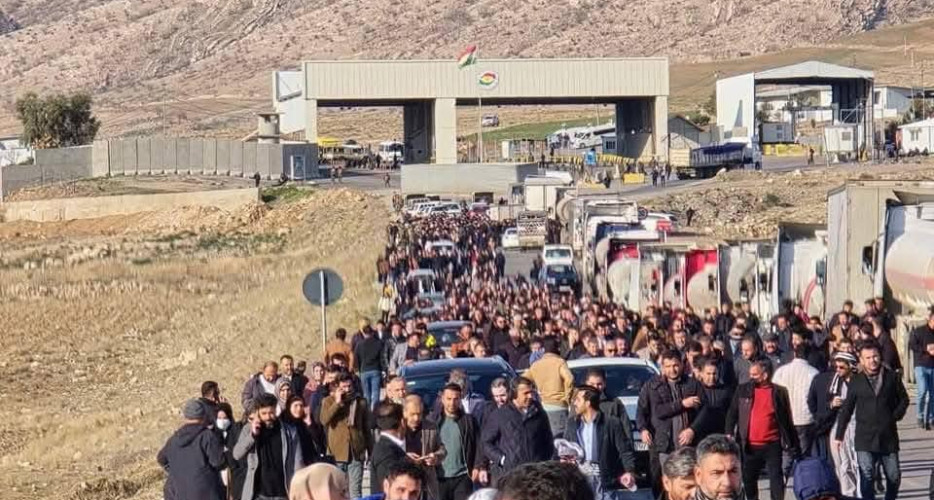
In late February, tensions escalated as teachers and public sector employees blocked oil tankers on the Arbat-Sulaymaniyah road to protest the ongoing salary crisis. They accused the Kurdistan Regional Government (KRG) of failing to implement Iraq’s federal salary distribution program, known as Tawteen.
On the Arbat-Sulaymaniyah road, Confrontations occurred between demonstrators and oil alleged tanker drivers attempting to pass through the blockade. A large number of tankers were diverted from the area as a result. Previously in Erbil Province, security forces intervened, preventing protesting teachers from reaching Erbil to protest outside the United Nations compound. Tear gas was used to disperse demonstrators at the Degala checkpoint.
On February 11, after 15 days of hunger strike, striking teachers and employees in Sulaymaniyah suspended their protest following a large public demonstration. Earlier that day, shops and markets in Sulaymaniyah and Halabja closed for an hour in solidarity. Writers, religious scholars, and activists joined a rally urging hunger strikers to prioritize their health while continuing their fight through alternative means.
Ongoing Oil Dispute Delays Resolution
The KRG claim that the financial troubles have been exacerbated since March 2023, when oil exports through the Iraq-Turkey pipeline were halted. The stoppage followed an international arbitration ruling against Turkey for allowing Erbil to export oil independently since 2014.
In an attempt to resolve the crisis, the Iraqi parliament amended the federal budget in February 2025 to increase transportation and production fees for oil companies in the Kurdistan Region. Under the budget law, Erbil is required to supply 400,000 barrels of oil per day to the State Oil Marketing Organization (SOMO) for export. The budget amendment also mandates a committee to determine production costs before Baghdad finalizes financial settlements with the KRG. Until an international company determines the production costs, Baghdad has agreed to pay the Kurdistan Region $16 per barrel of oil.
A significant meeting involving the KRG, the Iraqi government, and international oil companies in Baghdad concluded without reaching an agreement, despite ongoing efforts. A high-ranking source informed Peregraf that the oil companies are insisting on the resolution of outstanding debts amounting to $1 billion prior to the resumption of exports. Baghdad has declined to address these debts, as they are incurred by the KRG, resulting in a stalemate in the negotiations.
Even as U.S. officials push for a quick resolution, Baghdad has yet to commit to a financial settlement. Iraqi Oil Minister Hayan Abdul Ghani previously announced that oil exports from the Kurdistan Region would begin at 185,000 barrels per day and gradually increase. However, as of February 28, no official decision has been made.