Peregraf
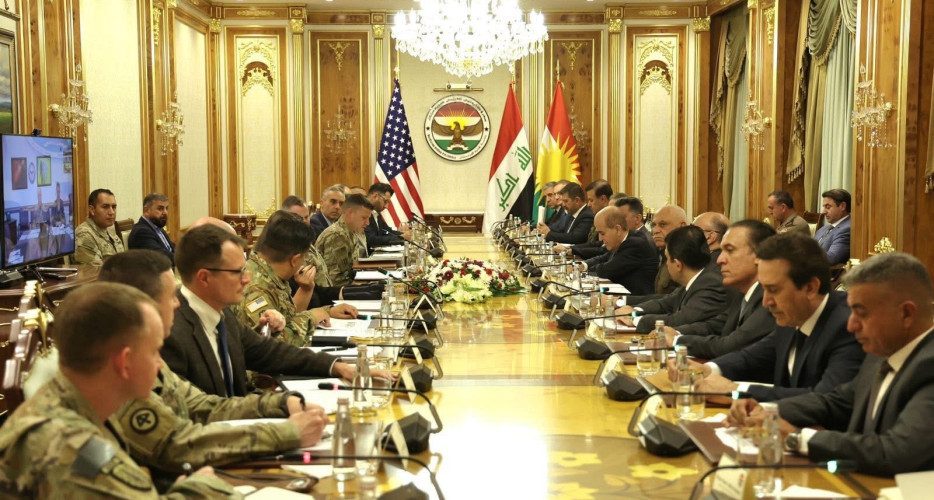
The Kurdistan Region Presidency announced that another round of joint meetings was held between relevant institutions of the Kurdistan Regional Government (KRG) and a U.S. military and diplomatic delegation to review the ongoing reform process of the Peshmerga forces.
According to the statement, the meeting focused on the importance of unifying the Kurdish forces, the progress achieved so far, and the obstacles that remain. Both sides reaffirmed their joint efforts to accelerate the process and strengthen coordination and cooperation.
The talks came a day after Prime Minister Masrour Barzani, overseeing the reform process, introduced new measures to advance unification efforts at the Ministry of Peshmerga Affairs. Barzani said several “important decisions” had been taken, particularly on financial accountability and restructuring of forces.
“All components of the Peshmerga must have only one accounting unit within the framework of the Ministry of Peshmerga and under the supervision of the KRG Ministry of Finance,” Barzani declared, stressing that the reorganization of units must align with broader government reforms.
He also called for better protection of veterans’ rights, ordering the expedited processing of retirement cases and ensuring that legal or technical issues do not delay payments. Barzani renewed his appeal to Baghdad to unify Peshmerga salaries with those of the Iraqi army, saying: “The Peshmerga is part of Iraq’s defense system, and their entitlements should reflect that.”
Persistent Challenges
Despite these measures, the reform process faces significant hurdles. A July 2025 report by the U.S. Department of State’s Office of Inspector General warned that political rivalries, financial constraints, and stalled integration continue to undermine efforts.
At the center of the problem is the 2022 Memorandum of Understanding (MoU) between the U.S. and KRG, which laid out a four-year roadmap to integrate partisan forces—namely KDP-aligned Unit 80 and PUK-aligned Unit 70—into a single, non-partisan structure under the Ministry of Peshmerga Affairs (MoPA).
But U.S. officials say progress has been limited. “Despite formal commitments, Peshmerga units remain fragmented along party lines, with little meaningful progress toward true unification,” the report noted.
Analysts argue that the entrenched rivalry between the Kurdistan Democratic Party (KDP) and the Patriotic Union of Kurdistan (PUK) is the core obstacle. Both parties continue to maintain control of their affiliated forces, weakening MoPA’s authority and enabling corruption, including the persistence of so-called “ghost soldiers” on payrolls.
Since 2016, the U.S. and European partners have provided training, funding, and equipment to professionalize the Peshmerga. However, coalition support is conditional: only non-partisan brigades officially transferred to MoPA are eligible for stipends and aid. So far, around 72,000 soldiers have been moved into Regional Guard Brigades, leaving thousands still outside the framework.
Meanwhile, budget disputes between Erbil and Baghdad have delayed salaries, undermining morale among troops. U.S. officials have cautioned that future support could be reduced if Kurdish leaders fail to fulfill their MoU commitments.
Observers warn that without genuine political will from both the KDP and PUK, the reform agenda risks collapse. “It’s not enough to focus solely on the Peshmerga. Broader reform of Kurdistan’s internal security forces and their party control is essential for long-term stability,” the U.S. report stressed.