From Blockade to Convoys: Barzani’s Calculated Move on Rojava—Strategic Shift or Image Rescue?
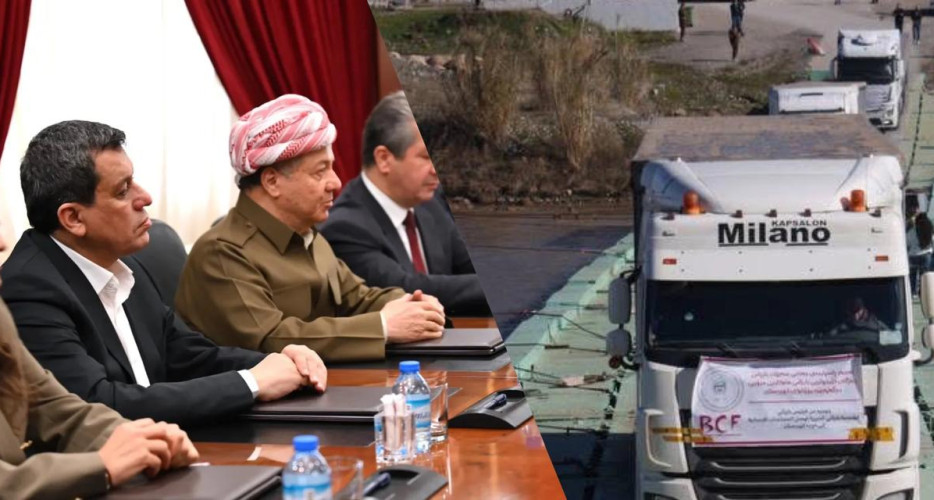
Peregraf — For years, relations between the Kurdistan Democratic Party (KDP) and Rojava—Western Kurdistan—were defined by obstruction, political hostility, and deliberate disengagement. As recently as 2023, aid convoys bound for Rojava were blocked at the Fishkhabur (Semalka) border crossing, even in the aftermath of a devastating earthquake. Today, the same party is facilitating humanitarian assistance and presenting itself as a partner to Rojava. This stark contrast—between past obstruction and present cooperation—demands close scrutiny, particularly given the KDP’s long-standing regional alliances and strategic calculations.
A Record of Alignment, Not Neutrality
The KDP’s strained relationship with Rojava and the Syrian Democratic Forces (SDF) has never existed in isolation. It has been deeply shaped by the party’s strong political, economic, and security ties with Turkey. Ankara has consistently viewed the SDF as an existential threat, equating it with the PKK and openly advocating for its dismantling. President Recep Tayyip Erdoğan has made no secret of his hostility toward the autonomous administration in northern and eastern Syria, while simultaneously positioning himself as a staunch supporter of Ahmed al-Sharaa and armed groups aligned against SDF-controlled areas.
Within this regional framework, the KDP’s repeated closure of the Fishkhabur crossing—often justified on technical or administrative grounds—was widely interpreted as a political act consistent with Turkish interests. During critical periods of siege, military escalation, and humanitarian emergency, Rojava remained isolated not only by hostile states, but also by a Kurdish party that controlled its most vital gateway to the outside world.
The 2023 earthquake marked a particularly revealing moment. While civil society groups and volunteers across Kurdistan—especially in Sulaymaniyah—mobilized large quantities of aid for Rojava, the KDP prevented much of it from crossing. At the time, public sentiment was unambiguous: Kurdish sympathy overwhelmingly lay with the people of Rojava. Yet once again, obstruction prevailed over solidarity.
Normalization Under New Regional Conditions
It is worth noting that at the beginning of 2025, as the peace process in Turkey entered a new phase, relations between the Barzani-led KDP and Rojava also began moving toward a form of normalization. Some observers argue that this shift did not emerge organically, but rather reflects a strategic role assigned to Barzani by Turkey, allowing him to act as an intermediary while Ankara recalibrated its regional approach without formally altering its position on the SDF.
If this assessment is accurate, the KDP’s current engagement with Rojava may be less about reconciliation and more about function—serving as a controlled channel through which Turkey manages Kurdish affairs beyond its borders, while keeping its core security doctrine intact.
A Reversal Under Pressure
On January 21, 2026, the Barzani Charity Foundation (BCF) dispatched 67 trucks of food and non-food aid to Rojava, accompanied by 150 staff members tasked with overseeing distribution. The move comes amid renewed displacement caused by attacks from armed groups affiliated with the Syrian government, forcing hundreds of families to flee toward Qamishli under severe humanitarian conditions.
This development coincides with an unprecedented wave of Kurdish unity. Protests in support of Rojava have erupted across Kurdistan and throughout the Kurdish diaspora in Europe, while international attention has increasingly focused on the vulnerability of SDF-administered areas.
In such a political climate, the KDP’s shift raises an unavoidable question: is the party responding to humanitarian necessity—or adapting to a moment in which opposing Rojava has become politically indefensible?
State Institutions at the Service of the Barzani Charity Foundation
Following the launch of the aid campaign, the entire governmental apparatus within KDP-controlled areas was mobilized to support the Barzani Charity Foundation. Provincial administrations, security bodies, and local authorities were effectively placed at the service of a single charitable institution closely tied to the Barzani family.
This level of institutional mobilization stands in sharp contrast to past practice, where other governmental or non-governmental organizations were denied similar access or facilitation. Rather than enabling a pluralistic humanitarian response, the state apparatus was used to centralize aid collection, branding, and delivery under the BCF’s name.
In a joint statement issued on January 22, 2026, the governors of Erbil and Duhok, along with the independent administrations of Soran and Zakho, declared:
“Following the emergence of a complex and unstable situation for our fellow citizens in Rojava, and as a national and moral duty, we have collectively announced a campaign to collect and deliver aid to our brothers and sisters in Rojava. To this end, campaigns have commenced across all our administrative boundaries, and our citizens are participating with great enthusiasm. All details regarding the aid will be published by the Barzani Charity Foundation in the future, and all supplies and necessities will be transported to Rojava by BCF teams.”
The statement effectively positioned the BCF as the sole legitimate channel for humanitarian engagement, raising concerns about politicization, transparency, and the use of state resources to enhance the foundation’s—and by extension, the KDP’s—public image.
Turkey, the SDF, and an Unresolved Contradiction
Despite this visible outreach, the central contradiction remains unresolved. The KDP maintains one of the closest relationships with Turkey of any Kurdish political actor, while Ankara remains unequivocally committed to dismantling the SDF.
This raises fundamental questions:
Is the KDP prepared to jeopardize its strategic partnership with Turkey for the sake of Rojava and the SDF?
Or does it believe it can leverage its relationship with Ankara to soften—or eventually change—Turkey’s position?
And if so, does the KDP actually possess the political leverage to influence a policy Erdoğan has defined as a core national security priority?
So far, there is little evidence that Turkey’s stance has shifted, or that the KDP has publicly challenged Ankara’s calls to dismantle the SDF. Without such evidence, the KDP’s current posture risks appearing performative—aimed at Kurdish public opinion rather than the regional actor most responsible for Rojava’s vulnerability.
Image Management and Political Ambition
At the same time, Masoud Barzani has intensified his diplomatic engagement on the Syrian file, including hosting meetings involving SDF commander Mazloum Abdi and holding discussions with Syrian actors. These moves align with Barzani’s long-standing ambition to be recognized as a Kurdish “Marja”—a supreme political reference capable of mediating across borders.
Yet this ambition collides with political memory. For many Kurds, particularly supporters of Rojava, the image of the KDP as a gatekeeper enforcing isolation has not faded. Humanitarian aid delivered today cannot erase years of closures, nor can symbolic diplomacy substitute for a clear stance on the legitimacy and future of the SDF.
A Test Beyond Humanitarian Aid
Ultimately, the credibility of the KDP’s shift toward Rojava will be measured not by aid convoys, but by consistency and political risk. Will Fishkhabur remain open in future crises? Will the KDP publicly oppose attempts to dismantle the SDF? Will it use its ties with Turkey to defend Rojava—or continue to avoid confronting Ankara?
Without clear answers, the current cooperation risks being understood as tactical repositioning rather than genuine strategic transformation. In a moment when Kurdish unity is driven from below—by popular solidarity, protests, and shared outrage—the KDP faces a decisive test: whether it is willing to align its regional alliances with Kurdish public sentiment, or merely adjust its messaging while preserving the same underlying policy.
For now, the distance between past obstruction and present cooperation remains wide—and unresolved.