PEREGRAF— Bwar Qadir
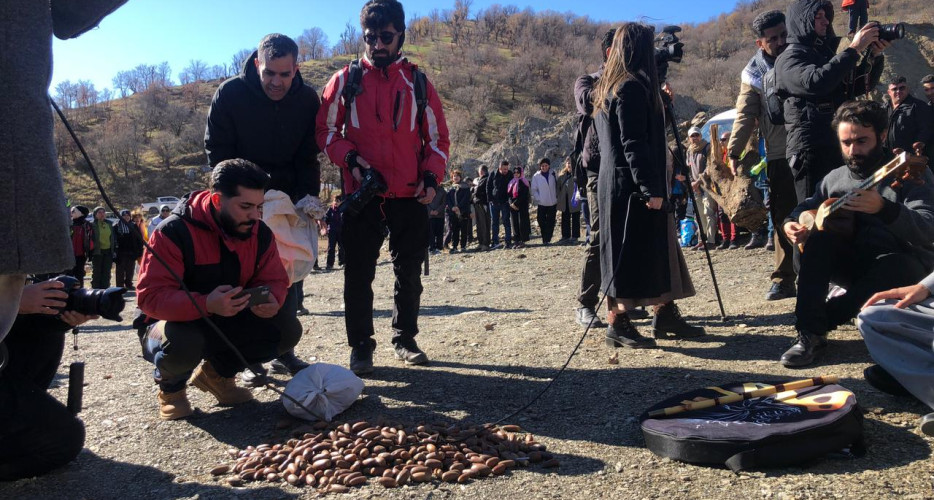
Dressed in traditional Kurdish attire and radiating enthusiasm, Asma climbs Mount Kwawa in Penjwen. Carrying a bag of acorns, she pauses at various intervals to plant them, assisted by fellow members of a volunteer collective.
The group represents a cross-section of society, drawing participants from across the Kurdistan Region, particularly the Sulaymaniyah Governorate. On an early autumn morning in 2025, they arrived at the mountains of Penjwen to carry out their mission.
"I place every acorn into a hole with the hope that it will turn green," said 23-year-old Asma Hassan. A graduate of the College of Nursing at the University of Sulaymaniyah, Asma joined the campaign after hearing about it from a friend. Despite her medical background, environmental preservation is a primary concern for her; by the end of the day, she had planted a significant number of acorns.
The planting initiative in Penjwen marks the third activity of the "Zagrosana" campaign. The movement began in Qaradagh with 150 volunteers planting 10,000 acorns, followed by a second phase in Darbandikhan, where 200 participants planted 15,000 acorns.
Shler Samad, the coordinator of the Zagrosana Network, told Peregraf: "In Penjwen, 400 people participated, collectively planting 20,000 acorn seeds." She noted that the acorns were provided by the volunteers themselves and that the campaign is set to expand to several other areas.
Established in 2018, Zagrosana aims to plant and revitalize the environments of areas situated along the Zagros mountain range. The campaign is not limited to Sulaymaniyah; similar initiatives are conducted across various regions in Northern (Turkish), Western (Syrian), and Eastern (Iranian) Kurdistan. These activities generally take place during the autumn and last for approximately one month.
The term "Zagrosana"—derived from the Zagros mountain range with the Kurdish suffix "-ana," meaning "in the manner of" or "pertaining to"—refers to the dedicated environmental network and volunteer campaign. It represents a grassroots movement committed to the ecological restoration and revitalization of the natural landscapes across the Zagros mountains, which span various parts of Kurdistan. Beyond its literal meaning, the name symbolizes a commitment to indigenous conservation, focusing on planting native species like the oak to ensure the sustainability of the region's unique ecosystem. By uniting volunteers from diverse backgrounds, Zagrosana serves as both a practical reforestation effort and a cultural statement on the importance of preserving the ancestral mountain environment against the threats of climate change and deforestation.
"Since 2018, we operated as individuals or very small groups. For instance, mountaineering groups would carry a quantity of acorns to plant while hiking," Samad explained. "However, the network expanded this year, with five centers and organizations now participating." She highlighted that one of the primary challenges is the difficult financial situation of the public, as participants must personally cover their own transportation and food expenses.
The total forest area in the Kurdistan Region, including both natural and man-made forests, stands at 2,542,993 dunams. Of this total, 35,472 dunams consist of artificial plantations.
Sarezh Aziz, 53, a native of Eastern Kurdistan who has lived in Sulaymaniyah for eight years, expressed her joy regarding the Zagrosana campaign. "I want to make my homeland green," she said. She offered one request to the public: "It is fine if some people do not participate in greening efforts, but they should at least not destroy it—do not burn the trees and do not cut them down."
Aziz, who manages a mountaineering and environmental group, noted after planting several acorns that planting via seeds has a higher success rate than using saplings. She explained that seeds establish their own roots directly in the soil, whereas saplings must struggle to readapt their root systems to a new environment.
Due to global warming, international standards for green space ratios have been raised from 15% to 25%. Every country is expected to increase its green coverage to meet or exceed this level. According to data published by the Environmental Board, the green ratio in the Kurdistan Region—including both urban areas and forests—has reached approximately 20%.
Yerivan Shaswar, an expert in agriculture and air pollution and one of the organizers of Zagrosana, was on-site to provide scientific guidance to participants on proper planting techniques.
He explained to Peregraf that acorns have specific requirements for growth. Unlike other seeds, the point from which the acorn sprouts must be positioned facing downward or laid horizontally. For a successful yield, the seed should be covered with 10 to 15 centimeters of soil to prevent it from being washed away by water and to make it less accessible to animals.
"Whether the acorn grows or is eaten by a wild animal, the impact is the same for us—it is all part of revitalizing nature," Shaswar said. "Sometimes acorns are worm-eaten or weak due to climate change. If they do not grow, let them serve as food for wildlife."
Trees and green spaces are vital in mitigating the effects of climate change. According to United Nations warnings, Iraq, including the Kurdistan Region, is the fifth most vulnerable country to these changes. Consequently, the region loses tens of thousands of dunams of fertile land and forest annually, in addition to other environmental disasters.
Awara Ahmed, the Director of Forestry and Rangelands in Sulaymaniyah, told Peregraf: "This group did not approach us to request coordination so that we could work together. However, if the work is conducted in an organized and scientific manner, it is very heartening, and we commend them."
The Kurdistan Region relies on Law No. 10 of 2012 for the protection of forests and related matters. A specific clause in this law empowers the government, in coordination with relevant parties, to plant trees in areas facing deforestation.
The Forestry Directorate currently lacks comprehensive statistics regarding the extent of damage caused by forest fires or the rate of natural green space recovery. Awara Ahmed attributed this to administrative hurdles: "We face a shortage of staff and a high workload. For example, we only have two to three employees dedicated specifically to Mount Goyzha in Sulaymaniyah City."
In recent years, fires caused by various factors have damaged forests, wildlife, and the environment across multiple regions. Most recently, in July 2025, more than five thousand dunams of natural forest were destroyed by fire in Halabja.
While agricultural experts suggest it is difficult to predict the exact success rate of the Zagrosana campaign due to a lack of formal studies, the group attempts to maximize survival rates by using native seeds. For example, acorns from Penjwen were planted in Penjwen, while seeds from Baranan were planted in the Baranan area.
"We chose acorns because the mountains of Kurdistan are the natural home of the oak tree," Yerivan Shaswar said. "Natural forests must be expanded using the species that originally grew there to ensure success. Furthermore, the oak is a sturdy tree, well-adapted to the region, and requires little maintenance."
The Zagrosana volunteers are instructed on scientific planting methods as they seek out the natural habitats of the oak, aiming to increase green cover and prevent global climate change from turning the mountains barren.
"In this campaign, we have taken great care to protect the environment and animals," Shler Samad concluded. "We said: we will plant acorns for the squirrels and rodents to eat as well. If only one thousand out of ten thousand acorns grow, that is a significant success for us and a cause for joy."