The Cost of a Payroll State: One in Five Kurdistan Residents, 11 Trillion Dinars a Year
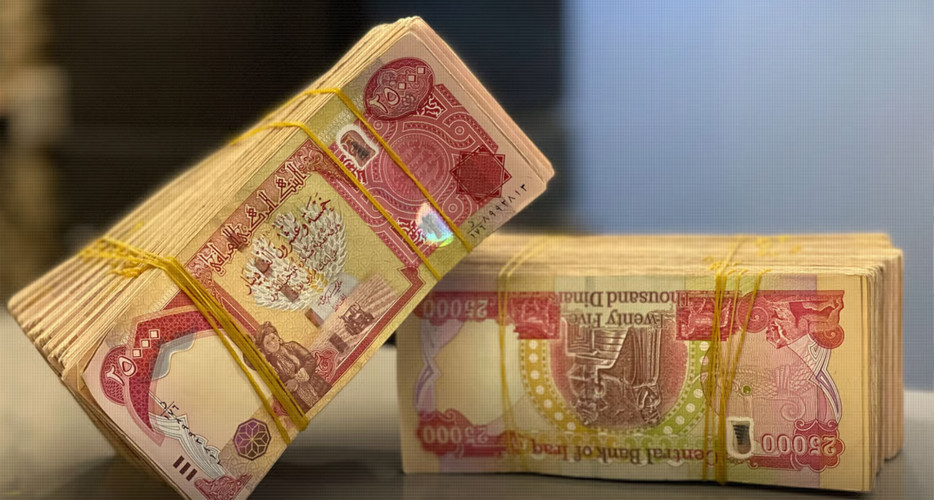
Peregraf- The Kurdistan Regional Government's (KRG) latest payroll data, obtained by Peregraf from the Ministry of Finance's Book of Activities and Reforms (2019–2025), offer the clearest picture yet of how the government's finances are structured. Examined alongside the results of Iraq's October 2024 general population census — whose preliminary findings were announced in November 2024 — the figures reveal that the KRG is confronting not only a revenue problem but a deep structural spending problem.
According to the census, the Kurdistan Region has a population of 6,519,129 people, including 2,517,534 in Erbil, 2,401,724 in Sulaymaniyah and Halabja, and 1,599,871 in Duhok.
Against that population, the Ministry of Finance reports that 1,190,391 people receive monthly government payments, costing the treasury 945.8 billion Iraqi dinars (IQD) every month, or approximately 11.35 trillion dinars annually.
The numbers indicate that one out of every 5.5 residents in the Kurdistan Region receives a government salary, pension, or benefit every month. Put differently, government payments reach 18.3 percent of the region's entire population. Because most recipients support families, the livelihoods of a majority of Kurdistan's residents are directly or indirectly tied to the government's ability to meet payroll.
That dependence illustrates why every financial dispute between Erbil and Baghdad quickly becomes a social and political crisis.
The data also suggest that the KRG has developed the characteristics of what economists describe as a payroll state. Rather than functioning primarily as a government that finances public services and development projects, its budget is overwhelmingly dedicated to recurring personnel obligations.
Only 382,350 people — or 32 percent of all recipients — are active civilian employees working in government institutions.
The remaining 68 percent are made up of military personnel, security forces, retirees, contract workers, social welfare beneficiaries, and families of martyrs and Anfal victims. In other words, for every active civil servant, there are more than two other people receiving government payments outside the civilian workforce.
This reflects decades of conflict, political compromise, and the expansion of social protection programs, but it also means that the government's obligations extend far beyond paying the current workforce.
The payroll data reveal another defining characteristic of the KRG budget: the central role of the security sector.
Combined, the Peshmerga, Peshmerga pensioners, Interior Ministry forces, and Asayish account for 421,598 people — or 35.4 percent of everyone receiving government payments.
Their combined monthly payroll reaches 391.8 billion IQD, representing 41.4 percent of the government's entire monthly payroll.
In practical terms, more than four out of every ten dinars spent on salaries go to security institutions.
Given the Kurdistan Region's security responsibilities and history, such spending carries a degree of context. Yet it also limits the government's capacity to invest in education, healthcare, infrastructure, and economic diversification.
Pension obligations represent another growing structural challenge.
The government pays 201,337 civilian pensioners and 139,015 retired Peshmerga fighters, for a combined total of 340,352 retirees.
Their monthly pensions total 222.8 billion IQD, accounting for nearly a quarter of total payroll spending.
Unlike infrastructure or development spending, pensions cannot easily be deferred during fiscal crises. As the public workforce ages, pension obligations will continue to grow, consuming an ever-larger share of future budgets unless structural reforms are introduced.
The data also show that the government has become the Kurdistan Region's largest social safety net.
When retirees, social welfare beneficiaries, and families of martyrs and Anfal victims are combined, the government supports 494,521 people — equal to 41.5 percent of everyone on the payroll.
These payments serve a critical social function, but they also create permanent financial commitments that are difficult to reduce, even during periods of declining revenue.
Another important finding concerns the overall size of the public sector.
With 382,350 active civilian employees serving a population of 6.52 million, the region has approximately one civil servant for every 17 residents. When all government-paid categories are included, there is one government payroll recipient for every 5.5 residents.
The figures reinforce a long-standing feature of Kurdistan's economy: the government remains the largest employer and the primary source of household income. While this has helped maintain a degree of social stability, it has also discouraged private-sector expansion and left economic growth heavily dependent on public spending.
The report also reveals the extent of the government's off-payroll obligations.
The Ministry classifies 525,458 recipients — or 44.1 percent of all beneficiaries — as off-payroll or non-permanent, including contract workers and other categories receiving government payments. Although they receive lower average payments than permanent employees, they still cost the treasury 283.7 billion IQD every month.
This means nearly half of all government payment recipients fall outside the permanent civil service, further reducing fiscal flexibility.
The geographic distribution of payroll also provides important insights.
Erbil accounts for 585,364 recipients — or 49 percent of all beneficiaries — receiving 489.1 billion IQD, more than half of the government's monthly payroll.
Sulaymaniyah accounts for 436,740 recipients and 341.9 billion IQD, while Duhok records 140,206 recipients and 95.6 billion IQD.
At first glance, these figures appear to reveal major regional disparities. However, the Ministry's report explains that the salaries of Peshmerga fighters, Interior Ministry forces, Asayish personnel, and retired Peshmerga serving Duhok are administratively processed through Erbil. Likewise, security personnel and several beneficiary groups in Halabja are paid through Sulaymaniyah.
This accounting method inflates Erbil's payroll figures while understating Duhok's, meaning the governorate-level data should not be read as a true reflection of the geographic distribution of government employment.
Halabja presents perhaps the clearest demographic warning.
Of its 15,334 recipients, nearly 63 percent are civilian pensioners, while only 20 percent are active civil servants.
Retirees outnumber active employees by more than three to one, illustrating how pension obligations increasingly dominate public finances even in the region's smallest governorate.
The salary data also reveal notable differences in average payments across sectors.
Asayish personnel receive average monthly salaries of approximately 1.56 million IQD, followed by Interior Ministry forces at roughly 1.21 million IQD. Civil servants average around 958,000 IQD, while Peshmerga fighters receive about 808,000 IQD. Pensioners receive approximately 630,000 to 690,000 IQD, while social welfare beneficiaries receive an average of only 145,000 IQD per month.
These differences reflect varying legal entitlements and responsibilities, but they also demonstrate that security institutions command significantly higher personnel costs than civilian sectors.
Perhaps the most important conclusion is not political but structural.
Nearly all of the KRG's payroll categories represent legally protected obligations. The government cannot readily reduce pensions, security salaries, welfare payments, or benefits for families of martyrs and Anfal victims.
As a result, when oil revenues decline or transfers from Baghdad are delayed, the KRG has very limited room to adjust spending. Capital projects, infrastructure investment, and development programs are typically deferred first, while salary payments become the central issue in every fiscal crisis.
The figures therefore suggest that the KRG's principal budgetary challenge extends beyond securing additional revenue from Baghdad or expanding oil exports. The deeper problem lies in the composition of spending itself.
Annual payroll obligations now exceed 11 trillion IQD, leaving only limited fiscal space for infrastructure, economic diversification, investment, and long-term development. Security institutions consume more than 40 percent of salary expenditures, pension liabilities continue to expand, and nearly half a million people rely on social transfers.
Taken together, the Ministry of Finance's data portray a government whose finances are increasingly dominated by fixed and growing personnel costs. Unless economic growth significantly outpaces payroll growth, or structural reforms are introduced, the KRG's budget will remain highly exposed to revenue shocks, with little flexibility to invest in the services and development needed to sustain long-term economic growth.
Peregraf analysis | The Cost of a Payroll State
— Peregraf (@PeregrafNews) June 27, 2026
1 in every 5 #Kurdistan residents depends on government payments.
1,190,391 people.
945.8 billion IQD every month.
11.35 trillion IQD every year.
Peregraf analyzed newly obtained #KRG Ministry of Finance data to examine how… pic.twitter.com/qXYJofndLi